
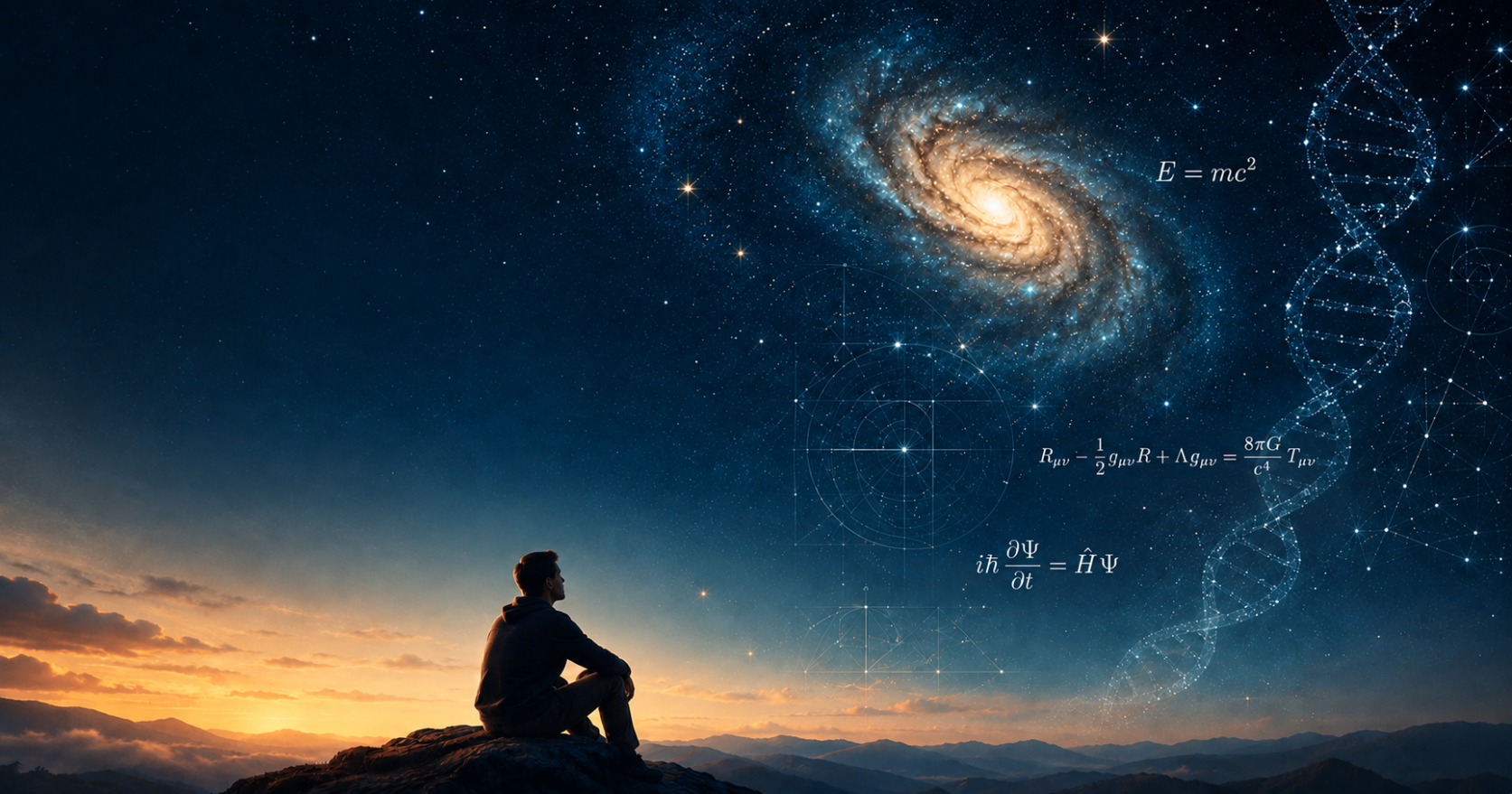
Does science make God unnecessary—or can the scientific picture of reality open the door to belief in a rational Creator? Here is a careful place to begin.
If you searched for evidence for God from science, you may not be looking for slogans. You may be asking a serious question: does modern science leave room for God, or has it made belief unnecessary?
Some people hear “science” and assume it points away from faith. Others study the universe, life, consciousness, and reason and begin to wonder whether reality is more open to God than they once believed.
eX-skeptic exists for that kind of honest exploration. Through story-driven conversations with former atheists and skeptics, Jana Harmon invites thoughtful people to consider why belief in God and Christianity may be reasonable, relevant, and worth another look.
What counts as evidence for God from science?
Evidence is not always the same as laboratory proof. We use evidence whenever we ask what best explains what we observe. A detective, historian, physician, scientist, and philosopher may all use evidence, but not always in the same way.
So when people ask about scientific evidence for God, they are usually not asking whether God can be placed under a microscope. They are asking whether the features of the natural world make more sense if reality comes from a rational Creator rather than from matter, chance, and necessity alone.
Science describes patterns, processes, causes, and effects within the natural world. But it also raises boundary questions: Why is there a universe at all? Why is it ordered? Why is it intelligible? Why does it allow life? Why do human minds seem fitted to discover truth?
A helpful starting point: The best question is not, “Can science replace God?” It is, “What kind of worldview best explains the world that science reveals?”
Science is not the enemy of honest faith
Many skeptics were taught that science and God are natural enemies. But science is a method of investigation, not a complete worldview. It can tell us an enormous amount about how the physical world behaves. It cannot, by itself, answer every question about why there is a physical world, what counts as truth, why reason works, or whether human beings have ultimate worth.
Christian faith, at its best, does not ask people to turn off their minds. It makes claims about reality: that the universe is created, that truth is knowable, that human beings matter, and that history is moving somewhere. Those claims can be questioned. They can also be examined carefully.
For a broader introduction, see Christianity for Skeptics. For a scientist’s story, listen to Finding God through Science – Dr. Michael Houts’ Story.
Four places science raises God-sized questions
Science does not answer every spiritual question. But several areas of scientific discovery have led thoughtful skeptics to reconsider whether God is a serious explanation.
1. The origin of the universe
If physical reality had a beginning, then the question becomes unavoidable: why is there something rather than nothing?
2. Fine-tuning
The universe appears structured in a way that permits life. Design remains a serious explanation worth considering.
3. Life and information
Living things contain meaningful, functional information. That raises questions about whether blind material processes are enough.
4. Consciousness and reason
Science depends on minds that can know truth. Why should an accidental universe produce rational insight?
The origin of the universe
For many skeptics, the first serious question is not “Which religion is true?” but “Why does anything exist?” The universe is vast, ordered, mathematical, and astonishingly coherent. A transcendent cause of space, time, matter, and energy is not an irrational idea; it is the kind of explanation many people begin to consider when the universe itself demands an explanation.
Fine-tuning and a life-permitting cosmos
The universe appears to operate within precise conditions that allow stars, chemistry, planets, and life. A skeptic may appeal to chance, necessity, or a multiverse. A theist may see evidence of purpose and design. The honest question is whether design should be dismissed before it is considered.
Life, information, and the limits of material explanations
Biology helps us understand inheritance, adaptation, development, and living systems. But the more we learn about life, the more profound the question becomes: why is matter capable of being organized into living systems with information, function, and purpose-like behavior?
Consciousness, reason, and the mind behind the search
Science depends on trust in reason. Christian belief offers a different starting point: the universe is intelligible because it comes from a rational Creator, and human beings can investigate it because our minds are not accidental intrusions into an otherwise meaningless cosmos.
For stories that explore this connection between science, reason, and faith, listen to When Science Points to God – Olivier Bonnassies’s Story, Believing Is Seeing – Dr. Michael Guillen’s Story, and Science Is Not Enough – Dr. Sy Garte’s Story.
Can science prove God exists?
Not in the way chemistry proves the composition of water or astronomy measures the motion of a planet. God is not one more physical object inside the universe. If God exists, He is the Creator and sustainer of the entire natural order.
That means the question of God is larger than science alone. It includes science, but also philosophy, history, morality, personal experience, and the life, death, and resurrection claims of Jesus.
So the better question may be: does science make belief in God more reasonable or less reasonable? Many former skeptics found that science did not eliminate God. Instead, it opened up questions that a purely material worldview struggled to answer.
The deeper question: which worldview fits reality?
Every person has a worldview, even if they do not call it that. Naturalism says reality is ultimately matter, energy, and impersonal forces. Christianity says reality begins with a personal, rational, good Creator.
The question is not whether Christianity has hard questions. It does. The question is whether Christianity, compared honestly with its alternatives, makes better sense of the whole picture: a universe with a beginning, laws, order, life, consciousness, moral awareness, beauty, suffering, longing, and love.
That is why stories matter. At Atheists Who Became Christians, you can read how former skeptics describe the slow accumulation of questions, evidence, relationships, and experiences that moved them from disbelief to belief.
How a skeptic can explore this honestly
If you are skeptical but curious, you do not need to pretend certainty. Start with one honest question and follow it carefully.
- Name your strongest assumption. Is it that science and God cannot go together? That materialism is the neutral view?
- Ask what would count as evidence. If no possible evidence could move you, the issue may not be evidence alone.
- Listen to one scientist’s story. Start with someone whose doubts sound familiar, then notice what changed.
- Compare worldviews, not caricatures. Ask which view best accounts for the whole of reality.
- Read one Gospel slowly. If God exists, the question eventually becomes personal: who is Jesus?
You can explore more through the eX-skeptic podcast, video interviews, and resources recommended by guests and Jana Harmon.
Want to keep exploring science and God without pressure?
Start with one honest story from a former skeptic or scientist. Listen for the questions they asked, the assumptions they reconsidered, and the evidence they found difficult to dismiss.
FAQs about evidence for God from science
Is there evidence for God from science?
Yes, many people see evidence for God from science in the origin of the universe, the fine-tuning of the cosmos, the emergence of life, the reality of consciousness, and the trustworthiness of reason. These lines of evidence do not force belief, but they can make belief in a Creator intellectually serious.
Does science disprove God?
No. Science explains many processes within the natural world, but it does not settle every question about why there is a natural world at all, why it is orderly, why it is intelligible, or why human beings can know and value truth.
Can science prove God exists?
Science cannot put God under a microscope or treat God as one object inside the universe. But scientific discoveries can contribute to a cumulative case that the universe is better explained by a rational Creator than by matter, chance, and necessity alone.
What is the strongest scientific evidence for God?
Different people find different evidence most compelling. Some point to the beginning of the universe, others to fine-tuning, biological information, consciousness, or the deep mathematical order of nature. For many former skeptics, the case becomes persuasive when several lines of evidence begin to converge.
Is fine-tuning evidence for God?
Fine-tuning can be understood as evidence for God because the life-permitting structure of the universe appears highly specific. Skeptics may propose chance, necessity, or a multiverse, but design remains a serious explanation worth considering.
Is this just a God-of-the-gaps argument?
It should not be. A stronger argument is not that God explains what science has not yet discovered, but that God explains why there is an ordered, intelligible, life-permitting universe that science can investigate in the first place.
Take the next honest step
You do not have to settle every question today. Begin with one story, one question, or one resource—and give yourself permission to examine the evidence carefully.
Prefer to reach out directly? Visit the contact page.