
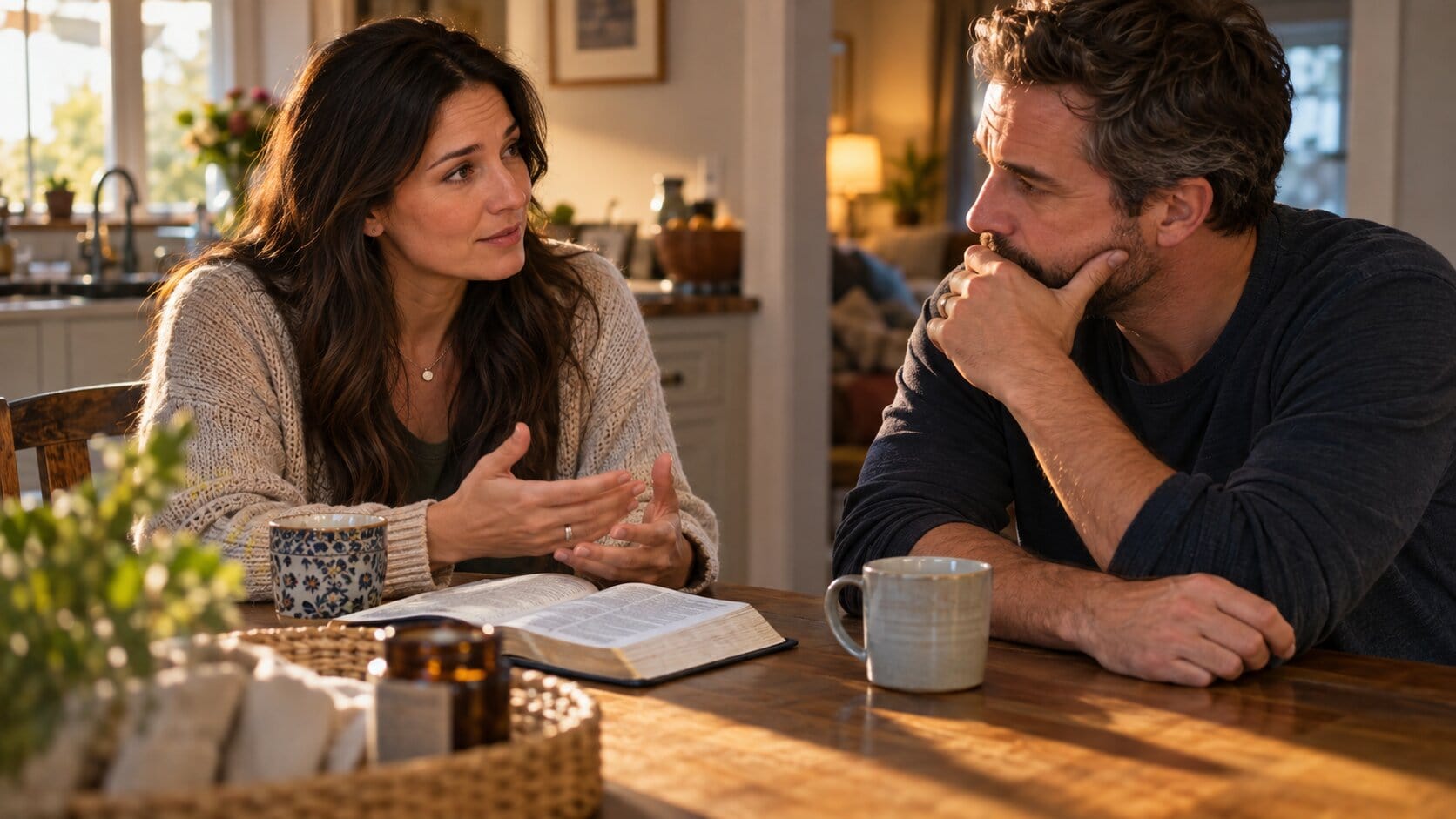
When faith becomes one of the deepest differences in a marriage, honest listening can matter as much as having the right words. Here’s how believing and skeptical spouses can navigate that difference without turning one another into a project.
When one spouse believes in God and the other doesn’t, the difference can reach much deeper than where you spend Sunday morning.
It can raise questions neither of you expected to ask: Are we still moving in the same direction? What will we teach our children? Can I talk about what I believe without starting another argument? Does my spouse secretly want me to change? What happens if neither of us does?
Sometimes the difference was there from the beginning. One spouse was a Christian and the other an atheist, agnostic, or simply uninterested in religion.
Sometimes it comes later. One spouse becomes a Christian. Or someone who once believed begins to doubt, deconstruct, or walk away.
Either way, a marriage that once felt settled can suddenly feel unfamiliar.
There are no slogans that make that easy. But difference does not have to turn your marriage into a debate neither person can win.
When faith becomes a fault line in marriage
Religious belief is rarely just one opinion among many.
What you believe about God can shape how you understand identity, purpose, morality, suffering, forgiveness, death, hope, family, and the future. When spouses see those things differently, it is understandable that both can feel unsettled.
The believing spouse may wonder, “How can the person closest to me not see something that has become central to my life?”
The skeptical spouse may wonder, “Is the person I married becoming someone different? Am I still enough? Is every conversation going to become an attempt to convert me?”
Those fears matter.
In The Case for Christ – Lee Strobel’s Story , Lee describes how disruptive it felt when his wife, Leslie, became a Christian while he remained an atheist. What had been a shared perspective was no longer shared. Her change raised serious questions about their marriage and eventually prompted him to investigate what she had come to believe.
Their story is compelling, but not because it provides a formula. It reminds us that a change in belief can feel deeply personal to both spouses.
Protect the marriage from becoming an argument to win
When something matters deeply, persuasion can easily become pressure.
The believing spouse may begin forwarding articles, correcting every objection, or treating ordinary conversations as opportunities for apologetics. The skeptical spouse may respond by dismissing Christianity, ridiculing religious practices, or assuming every expression of faith has an ulterior motive.
Soon, neither person feels heard.
Your spouse is a person to love, not a position to defeat. That applies in both directions.
Listening does not mean agreeing. Respect does not require pretending differences are unimportant. It means creating enough relational safety for each person to say what they actually think.
Instead of beginning with, “How can you believe that?” try, “Help me understand why this matters to you.”
Instead of asking, “How do I convince my spouse?” consider asking, “Do I really understand what my spouse believes—and why?”
Curiosity changes the tone of a marriage even when it does not change anyone’s mind.
If you’re the believing spouse: practice faith without pressure
If your spouse doesn’t believe in God, it can be tempting to carry a constant sense of urgency.
You may pray for your spouse. You may hope they become curious. You may long to share the most important part of your life with the person you love most.
Those desires are understandable.
But love makes room for another person’s freedom.
For couples who are already married, 1 Corinthians 7:12–16 is especially relevant. Paul addresses marriages in which one spouse believes and the other does not, and he does not treat unbelief itself as a reason to abandon an otherwise willing marriage.
That changes the question.
Instead of asking only, “How do I get my spouse to believe?” you can ask, “How do I love my spouse faithfully while we see this differently?”
That may mean:
- Letting your faith become visible through the way you live rather than turning every disagreement into a sermon.
- Asking permission before launching into an apologetics discussion.
- Taking your spouse’s objections seriously instead of assuming they simply need more information.
- Giving questions time.
- Maintaining Christian community without making your spouse feel as though the church is being recruited to pressure them.
- Being willing to say, “I don’t know,” when you do not have an answer.
Several eX-skeptic guests have remembered this kind of patience.
In I Don’t Need God – Mark Meckler’s Story , Mark describes entering marriage as an atheist with a Christian wife and remembers her as patient, accepting, and not pushy.
In Reasoning Requires Faith – Jeffrey Geibel’s Story , Jeffrey likewise describes a wife who continued to love him while he moved through serious doubts.
Their experiences do not guarantee what will happen in anyone else’s marriage. They do suggest something important: pressure is not the same thing as faithfulness.
If you’re the skeptical spouse: make room for sincere belief
Perhaps you are the one who doesn’t believe.
Your spouse’s Christianity may feel confusing, unnecessary, or even threatening—particularly if faith became important after you were already married.
You do not have to pretend to believe something you don’t. Intellectual honesty matters.
But so does taking your spouse seriously.
Ask what their faith actually means to them rather than assuming you already know. Christianity as your spouse understands and practices it may be different from the version you encountered earlier in life.
You can also establish honest boundaries.
Maybe you are willing to attend church occasionally but do not want to be presented as a believer. Maybe you welcome conversations about Christianity but do not want every disagreement interpreted as a spiritual problem. Maybe you are open to your children learning what Christianity teaches as long as questions are welcome too.
Those are conversations worth having clearly.
If you are curious about Christianity but not ready to believe it, Christianity for Skeptics: A Thoughtful Guide for Honest Questions is designed as a low-pressure starting point.
You do not have to borrow your spouse’s convictions. You can investigate the questions for yourself.
Talk about what faith actually changes
“Religion” can become a giant, abstract source of tension when the real disagreements are much more specific.
So make them specific.
Talk openly about the places where belief affects your shared life:
- Will either of you attend church, and how often?
- How will you explain God, Christianity, and skepticism to your children?
- What happens when a child asks whether God is real?
- Will charitable giving or church giving be part of the family budget?
- How will you handle prayer at meals?
- What religious traditions will be part of Christmas or Easter?
- How will you respond to expectations from parents, relatives, or church communities?
- Which moral decisions genuinely create disagreement, and which ones do you already share?
Do not assume that because your worldviews differ, every value differs.
A Christian and an atheist may both care deeply about honesty, fidelity, generosity, compassion, family, justice, and raising thoughtful children. Naming what you still share can keep disagreement from swallowing everything else.
What matters most to you here?
What are you afraid might happen?
What would respect from me look like?
Those questions often uncover a more important conversation beneath the theological argument.
What if one spouse’s beliefs changed after marriage?
A change in faith can be especially difficult when your marriage began with a shared worldview.
You may feel that the terms of the relationship changed without your consent.
For the Christian whose spouse has stopped believing, there can be grief and fear.
For the spouse who has deconstructed or become skeptical, there can be equal fear that honesty will cost them intimacy, belonging, or even the marriage itself.
That deserves compassion in both directions.
In Conversion, Deconversion, Reconversion – Jim Thring’s Story , Jim describes the effect his loss of faith had on a marriage that had begun with shared Christian belief. His wife’s response mattered during that period of doubt.
And Lee Strobel’s story presents the reverse situation: a previously agnostic wife becomes a Christian while her atheist husband remains opposed to Christianity.
Different direction. Similar disruption.
What helps in either situation is resisting the urge to panic.
A changed belief deserves serious conversation. It does not require you to settle the future of your marriage in one night.
Can a mixed-belief marriage work?
A spiritually mismatched marriage has real challenges. Pretending otherwise does not help.
But neither does assuming the difference automatically makes genuine love, respect, or a meaningful marriage impossible.
The more useful question is not simply whether a Christian and atheist marriage “can work.” It is whether two particular people can handle a profound difference with honesty, generosity, patience, and respect.
That means neither spouse should have to conceal what they actually believe.
The Christian should be free to be genuinely Christian.
The skeptic should be free to be genuinely unconvinced.
And both should be able to talk about those differences without contempt.
eX-skeptic’s bookstore includes the guide What If My Spouse Doesn’t Believe?, which brings together stories of hope and encouragement for people who feel alone in their faith. Those stories can be useful precisely because real marriages are more complicated than a list of rules.
If you hope your spouse changes
Both spouses may secretly hope the other person eventually sees things their way.
That is human.
A Christian may hope a skeptical spouse comes to believe. A skeptic may hope a Christian spouse eventually realizes faith is unnecessary.
The problem begins when hope becomes control.
People rarely become more open when they feel managed.
You can invite. You can ask. You can explain why you believe what you believe. You can listen. You can share a thoughtful eX-skeptic podcast episode if your spouse actually wants it.
But your spouse’s intellectual and spiritual journey must ultimately belong to them.
One of the most loving things you can say may be, “I want to understand you even if this takes time.”
When outside help makes sense
Some couples can navigate faith differences through patient conversation. Others get stuck in the same conflict again and again.
A qualified marriage counselor can be especially useful when discussions about faith repeatedly become arguments, when decisions about children feel impossible, or when either partner begins feeling unheard or emotionally unsafe.
Choose someone who can respect both spouses rather than treating one person as the problem that needs to be fixed.
If disagreement includes intimidation, threats, coercive control, or violence, the issue is bigger than religious difference. Prioritize safety and seek qualified local support. Patience in marriage does not require enduring abuse.
The next honest step
If one spouse believes and the other doesn’t, you do not have to resolve every theological question before dinner tonight.
Begin smaller.
Have one conversation in which the goal is not persuasion but understanding.
Listen to one story together.
Name one fear you have not said aloud.
Choose one practical disagreement and work through it rather than trying to solve your entire worldview difference at once.
Faith matters. So does the person sitting across from you.
A marriage can make room for serious questions when two people are willing to treat one another with honesty, patience, and dignity.
Feeling alone in your faith?
eX-skeptic’s What If My Spouse Doesn’t Believe? brings together real stories of hope and encouragement for people navigating belief differences at home. You can also hear former skeptics explain what helped—and what didn’t—as they reconsidered Christianity.
FAQs about marriage when one spouse believes and the other doesn’t
What does the Bible say if your spouse doesn’t believe in God?
For people who are already married, 1 Corinthians 7:12–16 is an important passage. Paul addresses marriages between a believer and an unbeliever and tells the believing spouse not to divorce simply because the other person does not share the faith if the unbelieving spouse is willing to remain in the marriage. The passage encourages faithfulness without promising that one spouse can control the spiritual decisions of the other.
Should a Christian divorce an unbelieving spouse?
Unbelief by itself is not presented in 1 Corinthians 7 as a reason for a Christian to leave an otherwise willing marriage. Real marriages can involve other serious circumstances, however, so questions involving abuse, abandonment, safety, or complex family situations deserve qualified pastoral, counseling, and when appropriate legal guidance.
What does “unequally yoked” mean if you’re already married?
The phrase comes from 2 Corinthians 6:14 and is often applied by Christians to the wisdom of entering a marriage with someone who shares the same faith. But when Paul directly discusses an existing marriage between a believer and unbeliever in 1 Corinthians 7, he encourages the believer to remain if the unbelieving spouse wants to continue the marriage. It is important not to confuse guidance about entering a relationship with guidance for a marriage that already exists.
How can I talk to my spouse about faith without arguing?
Begin with questions instead of conclusions. Ask what your spouse actually believes, what experiences shaped that perspective, and which concerns matter most. Agree that either person can pause the conversation if it becomes heated. The goal of every discussion does not have to be agreement; sometimes understanding is meaningful progress.
What should we tell our children if one parent believes and the other doesn’t?
Try to agree on an approach that is truthful about both parents. Children do not need to be asked to choose sides. A believing parent can explain Christianity sincerely, while a skeptical parent can honestly explain that they see the question differently. Both parents can encourage thoughtful questions while agreeing on shared family values wherever possible.
Can an atheist or skeptical spouse eventually become a Christian?
Yes, some do, and many eX-skeptic guests describe moving from atheism or skepticism to Christian belief. But their stories are not a formula or guarantee for anyone else’s spouse. A loving relationship should not depend on treating the skeptical spouse as a conversion project. Their questions and conclusions need room to be genuinely their own.
Start with one honest story
You do not have to settle everything at once. Hear from former atheists and skeptics who wrestled with belief, relationships, and difficult questions—and consider what their journeys might add to your own conversation.
Looking for a place to begin with questions about Christianity? Explore Christianity for Skeptics .