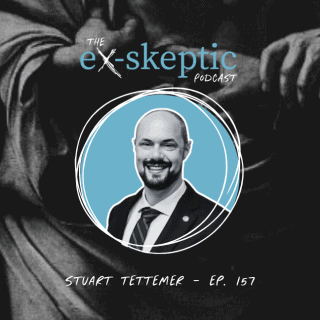

What happens when the worldview you embraced no longer seems capable of explaining the world you experience?
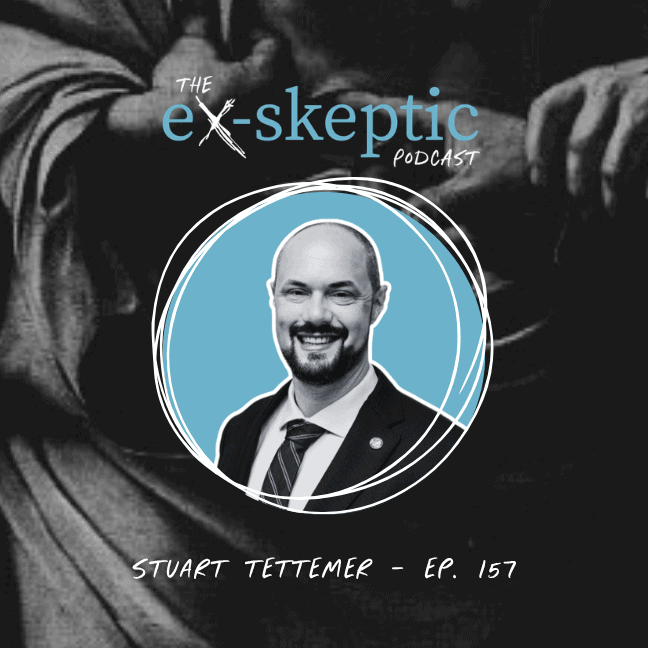
For Stuart Tettemer, atheism wasn’t a rebellion against God. It was simply the conclusion that seemed most reasonable. Raised in a Christian home, Stuart gradually drifted away from faith and eventually embraced atheism, finding intellectual confidence in the arguments of the New Atheists and a materialistic understanding of reality.
But over time, unanswered questions began to emerge.
Could consciousness be explained by matter alone? If free will is an illusion, what becomes of morality and responsibility? And why did a life centered on success and achievement leave him increasingly unsatisfied?
🎙️ Love the show? Support the mission and explore eX-skeptic merch here: https://ex-skeptic-shop.fourthwall.com/
Guest Bio:
Stuart Tettemer is the Mayor of Panama City Beach, Florida. A graduate of Cornell University with degrees in Information Science and Computer Science, Stuart spent years working as a software engineer in Silicon Valley and with technology startups before returning to Florida.
Today, he is passionate about community, discipleship, and helping others discover the truth and beauty of the Christian faith.
Resources Mentioned:
eX-skeptic Guides: https://exskeptic.org/bookstore/
Chapters
00:00 Intro
02:00 – Meet Former Atheist Stuart Tettemer
04:20 – Growing Up Christian and Drifting Away
08:46 – Why He Accepted Atheism Without Question
12:59 – How Science Shaped His Worldview
15:14 – Can Atheism Explain Life’s Meaning?
18:54 – The Mind-Body Problem and Consciousness
21:06 – Can Free Will Exist Without God?
23:16 – Exploring Buddhism and Meditation
25:09 – Why Success and Wealth Weren’t Enough
27:45 – The Sam Harris Argument That Changed Everything
30:06 – Discovering Eastern Orthodox Christianity
34:09 – Practicing Christianity Before Believing
41:02 – Finding Community Through Bible Study
43:18 – How Serving Others Transformed His Faith
46:49 – Are We Both Physical and Spiritual?
49:48 – Recognizing God’s Pursuit of Him
51:11 – Why Evidence Still Requires a Step of Faith
54:04 – How to Help Skeptics Discover Christianity
01:00:57 – The Transformative Reality of Faith
01:49:59 – Closing
Connect with eX-skeptic:
Website: https://exskeptic.org/
Facebook: http://www.facebook.com/exskeptic
Instagram: http://www.instagram.com/exskeptic
Twitter: http://x.com/exskeptic
YouTube: https://www.youtube.com/@exskeptic
Email info: info@exskeptic.org
eX-skeptic Transcript
Ep. 157
November 6, 2026
Intro
STUART TETTEMER: We know that God’s always pursuing you, but there is no person that reached out to me. I became not convinced of Christianity. I became convinced that materialistic atheism did not make sense. And then I started looking into it.
JANA HARMON: What happens when the worldview you choose, the one you believed best, explains reality? No longer feels like enough. For many who leave Christianity. Atheism seems to offer clarity. It resolves tension and removes what once felt uncertain, and for a time it can feel like the most honest conclusion.
But what if, over time, new questions begin to surface not just about meaning or purpose, but about whether atheism itself can fully account for the world we experience and the life we’re living.
Hello and welcome to eX-skeptic, I’m Jana Harmon. This is a podcast sharing unlikely stories of belief from former atheists and skeptics, and insights for those who are still searching and exploring.
But before we begin our next story, if you’re asking these kinds of questions yourself, you can explore our curated playlists on YouTube or visit eX-skeptic.org to find stories and resources tailored to your journey. And if you’d like to support this work, we’d be most grateful.
Now with the answers you once trusted begin to feel incomplete. Where do you turn next? If you’ve ever wondered whether atheism truly satisfies the deepest questions of your mind or your life, this conversation is for you. I hope you’ll come along to listen in to my conversation with former atheist Stewart Tettemer.
Welcome to eX-skeptic, Stewart. It’s so great to have you with me today.
Meet Former Atheist Stuart Tettemer
STUART TETTEMER: And nice to be here, Jana.
JANA HARMON: Wonderful. I’d love for the listeners to know a bit about you, Stewart, as we’re getting started. Can you tell us a bit about your education, the kind of work that you’re doing now and the things that you’re passionate about?
STUART TETTEMER: Sure I am. Um, I’m originally from Central Florida. Uh, Kissimmee, Florida. I grew up there. I went away to college to Cornell University, where I got an undergraduate degree in information science, systems and technology and a master’s degree in computer science. After that, I became a software engineer.
I was in Silicon Valley. I worked for a few big companies. And then, um, quite frankly, after paying off my student loans, figured I’d do something a little bit more risky. Uh, went through a few startups over that time I moved away from, um, Silicon Valley, Bay area of California, briefly in Colorado and then back to Florida.
And so right now I am mayor of Panama City Beach.
JANA HARMON: That’s a beautiful area of the world. Sugar beach is in the Emerald Coast. Uh, it’s really, really gorgeous. Probably a wonderful place to live. I don’t know what it would be like to be mayor, but. But certainly, a beautiful place to live.
Um, but of course, you’re not here to talk about the beach today. You’re here to talk about your story, which intrigued me when you actually published it in a local publication there. And I became privy to that article. And I’m just so excited for you to come and tell your story today. Uh, because you in the article, you talk about yourself as being an atheist at one time in your life, but you are not now.
So let’s, uh, let’s hear your story. Let’s start back at the beginning. In your childhood, you said you were born in Central Florida. Let’s start there with your family life and talk with me about growing up in Central Florida and your family, whether or not religion or God or the Bible had anything to do with your growing up years.
Growing Up Christian and Drifting Away
STUART TETTEMER: Yeah. Um, so I kind of typical middle class childhood growing up in Kissimmee. Enjoyed biking around, uh, Kissimmee, about 40,000 people at the time I was growing up. Um, it is a it is a tourist town, uh, right next to Disney World.
Uh, you know, it’s just a pretty mundane childhood. Played a lot of soccer. Um, I was always fairly good in school in terms of faith life, I grew up in the Methodist Church. My parents are faithful Christians. We prayed at meals. My dad, um, helped with Sunday school.
Uh, but then probably around right around the age of 13. We had ended up changing churches, and I think maybe part of that disruption and also I wasn’t when I was asking questions, I wasn’t getting solid answers. I remember asking and it was just very easy, if you don’t have the burden of proof, it’s very easy to play the skeptic, especially if someone’s, you know, not well trained in necessarily apologetics, and that’s the kind of answer you’re looking for.
So that that stuck with me. But I wouldn’t say there was a hard break. I think it was just ended up becoming less and less of my life. The transition to the new church. Um, and then taking a step back, that was just not a good fit for our family. So, we stopped attending Sunday services, and then I just defaulted, um, to atheism. So, I would say it wasn’t a wasn’t an important part of my life. Um, just what? Uh, Christianity did not remain and part of my life.
And so, I, I would say defaulted to essentially agnosticism. And this is in the 90s, in early 2000, the atheist, um, the New Atheist kind of revolution was starting to happen. And as someone who was online fairly early, I got exposed to some of that went away to college and I knew very few Christians. I don’t I don’t think I knew someone who was a practicing Christian in college. And so that was that was it was just the default. I was probably I was lukewarm throughout my childhood. And then even in terms of atheism.
And then I started I was on podcast really early. Sam Harris was one of my one of my favorites. And then I had some. I really should have taken a gap year between high school and college because I went from being from high school being easy to going to Cornell, uh, you know, I was middle of the pack at best. So, it became very hard.
JANA HARMON: As a teenager, I guess you had gone and you had participated in church. There were some troubling questions that seemed unanswerable in your Sunday school. Your, your family moved churches. you kind of drifted away. It sounded like you didn’t have a good reason to hold on to Christianity, that, um, socially, you know, you’re kind of drifting as a family.
And intellectually, it’s not providing solid answers. Um, and then you, you move into a highly stressed, more secularized Ivy League academic environment where no one is a Christian. So, there are a lot of reasons why you might have drifted, um, socially, educationally.
Oftentimes, um, when someone rejects belief in God and Christianity and you, you start to label yourself an agnostic or even an atheist. What did exactly that mean to you when you embrace that label or that identity?
Why He Accepted Atheism Without Question
STUART TETTEMER: It was not a conscious. It was kind of. It was. It was a little. It was a step by step process. So, to be entirely fair, I did not seek out, reasons why Christianity would be true I just defaulted in to, this does not make sense, I’ve not been given a good reason for it. I don’t see God in the world.
And then I went. Especially when I was consuming some of the new atheists. I went looking probably just for validation. And those guys seemed smart. Uh, you know, the idea of it being a conscious rejection, I don’t think that I was ever fully formed enough to make a decision on my own. I just let it just let it slide. It was okay. I don’t have, I don’t have I mean, listen, my dad, my mom, they’re there are good members of the community. They were great parents. They were always present with me.
There was, you know, there’s kind of the normal conflicts you would expect in a teenager in high schooler, but nothing that, you know, I never, um, thought they did. I always thought they loved me. So, there’s no there was no traumatic. It was essentially going from lukewarm to cold and then once cold looking into. And if you, instead of weighing. I think what was happening for me is instead of weighing the evidence, I was trying to validate my position.
So, when I, you know, kind of slid into did not have I mean, even in, uh, growing up. Uh, you know, my, my other than kind of a generic God discussion or acknowledging that God exists, we didn’t we didn’t talk about Jesus. We prayed at meals.
I didn’t have any friends who or anyone or anything other than cultural Christians. Even in my high school, there was there was one young lady who was actually on fire for the Lord. Everyone else was just normal. I’d say normal, lukewarm, uh, cultural Christians.
And so going into college, you know, I just really wasn’t ever presented with a counterargument or presented with a counter witness. I did not go seeking it. But, you know, I just I did not have anyone who would say, hey, you should consider changing your belief. There was, um, you know, um, and we can get into, I’m sure, or we’ll possibly get into this later. That’s actually the case essentially, throughout my conversion as well as I, you know, God was we know that God is always pursuing you and but there is no person other that reached out to me.
I became not convinced of Christianity. I became convinced that materialistic atheism did not make sense. And then I started looking into it.
How Science Shaped His Worldview
JANA HARMON: What were you learning or what were you accepting about atheism before you began to see some of its limitations?
STUART TETTEMER: They were presenting naturalistic explanations for, really, the miracles we see all around us. I would not have thought about it that way. Um, you know, uh, I will just say, you know, I was an engineering major. Um, you know, taking chemistry, physics, computer science, there was not any denigration of Christianity. Um, I don’t think. I don’t think anyone. Really. I mean, it just it was just. It wasn’t in the conversation at all. It seemed irrelevant.
And, uh, so for Sam Harris, a lot of his call it atheistic, atheistic, apologetic work is okay. Why? Why is there life at all? What does consciousness. What is consciousness? That was a question that stuck with me.
So, I was I was interested in. Okay, how do we explain this? I was coming at it from a. This makes sense. This is the spirit of the age. Help me understand it more. Not, oh, this doesn’t make sense yet. Um, so, I mean, it’s, I think just really my, um, my entire experience with atheism, is it just being the background, the cultural background of my life and not being presented and not searching for explanations that would deny materialistic atheism?
JANA HARMON: I just wondered if there were any other issues with regard to your own life or life at large that seem to make you scratch your head and go, hmm, I don’t know. I don’t know about that, even though there’s a presumption that that’s the truth. Yeah, the true story of reality. Supposedly.
Can Atheism Explain Life’s Meaning?
STUART TETTEMER: If the presumed default is naturalism, there are answers to many of these things based on an evolutionary perspective, or there are at least answers, that are presented. So, a basic answer to why is there life at all? And it’s kind of a cheat. And, you know, maybe I’m going to get the term for it wrong or my understanding of it wrong, but I’m just going to say my, my, the term I’m aware of and my understanding of it, this like this anthropocentric principle, which is of course, the universe had to create people because if it didn’t, we wouldn’t be here to see it.
Now that always, you know, you think about it for a little bit and it’s not the most intellectually satisfying. But if you’re not digging, it’s like, oh, okay, that’s kind of a cute trick. I mean, if you’ve studied any mathematics, you know that there are many cute tricks that, um, end up being, uh, you know, good have good explanatory power. I
n terms of the meaning of life. Um, you know, I suppose I wasn’t a particularly thoughtful person. Um, you know, obviously I thought about the meaning of life, but for me, I had this weird, weird theory because I was like, okay, what? What is it? What is it? What does my life matter? And so, I was like, okay, well, I impact other people, my impact of other people, and they impact other people. And so that’s the meaning of life is that have a positive impact on other people. That kind of ripples through behaviors.
My understanding of a naturalist perspective is it is a closed system. It actually does for the questions it asks provide to relate to a non-expert satisfying conclusions. There’s not. And, um, whenever you want to get into this, that. That’s what bursted out for me was the theory of consciousness. Because there’s not a satisfying. That’s the that’s where you go beyond. The ability of naturalism to explain consciousness.
That’s how God used my curiosity, the curiosity he gave me, um, to kind of poke that hole. It wasn’t morality because you can if you inherit a Christian society, Christian morality seems to make sense because it works. There’s nothing, um, to say. And if you’re not doing a deep investigation into it, there’s nothing to say. It’s like, okay, yeah, I could see how society would just evolve this way. That makes sense.
Um, so that that’s where it was for me is I there seemed to be to someone who was not spending detailed time reading papers. It seems to me the popular explanations there satisfying enough, um, to confirm what I already believed.
The Mind-Body Problem and Consciousness
JANA HARMON: Yeah, that makes sense that there were all of these explanations coming from your atheistic perspective, that seems satisfying until you ran into the mind body problem. It sounds like a consciousness where you actually had to write a paper and like you said, like you say, it’s interesting how you can take explanations on their face and they seem convincing, um, like you were doing for a number of different things and listening to voices of authority and experts and the new atheists and whomever.
But then you were called onto the carpet to take a look at this problem of consciousness, which is hard to explain if matter is all there is. So, walk us through that then. The mind body problem. How is there a mind if we are purely physical, right? If we live in a purely physical or naturalistic world?
STUART TETTEMER: My answer for that was unsatisfying. Uh, it was it was to just, uh. In computer science, we call it another layer of abstraction. We would. I just moved the problem down one step. I said, okay, there’s maybe just this dimension where physical reality, um, or where the consciousness lives, and there’s just an interaction between that dimension and our x, y, z, our x, y, z, t – our three dimensions plus time and our dimension. And we just haven’t found it yet. Okay, but there’s no evidence for that. I mean, there’s a philosophy class, but there’s no evidence for that dimension. Um, but that’s. But I knew it was a cheat. Uh, you know, I knew there was.
You know, we just have to. If I’m going to assume strict materialism, everything has to be materialistic. And then associated with that is the problem of free will. So, and then that starts to unravel. Pardon me. That says the that that has moral implications.
Can Free Will Exist Without God?
JANA HARMON: So, explain the problem of free will if you’re an atheist.
STUART TETTEMER: If the rules of reality, of physical reality. Reality as described by physics is all there is, then you are not there as an agent. You cannot make a, you are not making a decision as. As I mentioned before. My solution or my half solution to the meaning of life, this kind of series of waves of interacting behaviors. I mean, you’re simply the culmination of all your influences and then potentially randomness. That’s it.
So, you don’t have you can’t have free will. And then the moral implications of that. And this is something that to his tremendous credit, um, Sam Harris did engage with. He engaged with the problem of consciousness and the problem of moral culpability if you lack free will.
Um, his solutions to those were not satisfying. But if you if I’m, if I have no Agency, then I can’t be said to have responsibility for any of my actions, good or bad. Any more than a program I wrote could be blamed for doing something that I didn’t, that it wasn’t programed to, for doing what it was programed to do.
And I will just say there was a level of attractiveness just for their, quite frankly, their confidence. You know, they, they confidence. And some of them were, you know, quite amusing. Um, in the meantime, uh, it’s not that I, you know, was not engaged in kind of trying to refine my consciousness. I did go on meditative retreats.
Exploring Buddhism and Meditation
At some point, I had taken a trip to Japan, so I looked into Buddhism. They actually had I bought a little book on my Kindle to read while I was in Japan. Um, I. I personally found it unsatisfying. Um, its explanation of reality, but it seemed the most consonant with an atheistic perspective.
Um, so I was like, you know, if you take the metaphysical and just the physical, how does it affect by my behavior? You know, you do get a calming effect when you go into meditation. You do get a focusing of the mind when you go into meditation.
And I’ve taken some meditation classes in college as a, as a PE course. So, we were required to take a physical education at my university. So, I’d taken some and I’d actually gotten great benefit out of it. Um, so I’d explored that. I found that unsatisfying as well. Um, it’s just its explanation of life being suffering. Um, And, you know, of utter detachment from the world as being a goal, uh, was not just personally satisfying.
Uh, so that’s where I was is. Okay. I’m. Essentially inherited from the world, an atheist atheistic perspective. Almost everything except for these kind of edge cases. And we can discuss whether they’re actually edge cases or not. Um, it all makes sense. You know, we have good explanatory power. Science has taken us to the moon. And modern medicine has, uh, tremendously benefited our lifestyle.
Why Success and Wealth Weren’t Enough
I’m working in technology. Now, in the meantime. Um, you know, I’m. I’m fairly successful. Um, and, uh, by life is not particularly satisfying, I would. I start off early in my career. I would work a lot because it was just so fun to work. Um, and then eventually it gets old. Right. Um, and so I, I’m starting to just say, okay, you know what? What do I want out of my life? What’s my goal here?
Um, and it just seemed to be preparing for retirement. Um, for whatever reason, I was not interested in a family at that time. So, it was. I want to, you know, do good things in the world. You know, I want to influence positively, uh, it positively. Um, but I also just want to accumulate enough material wealth myself that I don’t have to worry about it when I’m old.
Um, so, you know, that’s not that’s also that’s also unsatisfying. So that for me, I guess it took living out my, living out my morals and my belief system over time to allow it to the unsatisfying nature of it to become apparent to me.
JANA HARMON: So, it became dissatisfying, not only intellectually in some ways, whether it’s the problem of consciousness in the mind body problem, or perhaps the dilemma with free will and not, and the lack of moral culpability for our own personal decisions, and then existentially, in your own life, it was dissatisfying as well.
Even though you tried these other seeming compatible, um, efforts, whether it’s Buddhism or meditation or work and finding trying to make your own purpose through work that that you were you were dissatisfied as seemingly everywhere you turned. So, what did you do with that?
The Sam Harris Argument That Changed Everything
STUART TETTEMER: Well, at some point, um, the turning, I mean, what did I do with that? I engaged in really in physical pleasure. Um, you know, I wouldn’t say overly hedonistic, but, you know, go out, play games, you know, um, you know, go hang out with friends, go out drinking, um, you know, purchase things. Um, you know, I’ve been making a decent amount of money, so, you know, I’ll go buy toys.
Um, and then at some point, I was listening to, um, I think the name of his podcast at the time, and it may still be the case. I was listening to a Making Sense episode from Sam Harris, and, you know, I wish I could go find this one to check my memory on it, but he essentially fully denied the existence of consciousness and free will at all.
Instead of saying, I have an explanation for it, he said, okay, you experience this consciousness. You’re actually you’re a passenger, right? You are. You’re a passenger in your body’s life. And his explanation for it not being apparent is he could go in to. These are not being real or an illusion is he could go into these meditative states himself at the time, and I don’t know if he’s still doing it. He was really selling these kind of meditation classes.
And lose a sense of self. You can lose your actual sense of self. He didn’t become unconscious, which is where my where the disconnect was. And I just remember thinking, well, that’s if that’s your explanation. That’s not an explanation. That doesn’t make sense. Okay. So if that doesn’t make sense, then it’s possible there is a God. There is something supernatural anyway. Something outside naturalistic explanations.
Discovering Eastern Orthodox Christianity
So I started investigating Christianity. Now I didn’t pick, I essentially. Because my perspective all supernatural, all non-naturalistic explanations were potentially equally valid. I did not say, oh, Christianity has a lot of evidence for itself. What I said was this is the the most accessible to the divine my culture has provided me. So I’m going to investigate that. If you’re if you’re doing an investigation, going to the place where you, you have the most opportunity to investigate, um, it seems like a logical place to start.
And so my investigation of that was mostly online, trying to find church communities. Uh, I was in California at the time. And I didn’t end up finding any church communities at the time online. Orthodox Eastern Orthodoxy was very popular. And so that seemed different enough from what I experienced in mainstream American Christianity. There’s also a strong sense of the mystical, um, that they preserve, a strong sense that they call it mystery, not mystery as in, it can’t. In a sense, it can’t be understood fully in this life.
So, when I moved to Colorado, I found the nearest Orthodox church. You know, it’s kind of counterintuitive because I said I wanted the closest to my culture in Christianity. And then I go to this fairly obscure, um, uh, faith community with which is Orthodoxy. But, uh, you know, I just figured, okay,
There’s not really a sense of this world being so infused with this world.
So I started attending Orthodox services. There’s a strong sense of reverence throughout the entire service. And then I started talking to the the pastor there, Father John, and he was just he was extremely kind, inviting. And also, for someone who is curious, there’s a lot to investigate. There’s a lot. I mean, there’s a deep tradition from the early Christian fathers up through, um, modern times. There’s a deep tradition to explore. So, it’s a very deep well.
And so I went through that. I became what they would call a catacomb. So that’s someone who’s looking to enter the church. And I stayed in taking those classes, talking with Father John. Uh, for, for actually a couple of years.
Practicing Christianity Before Believing
JANA HARMON: Can I ask you that? That’s very curious to me. I know you were curious and open to a better or greater explanation than naturalism was offering, but that’s different than you were attending a church. Did you believe at that point or through that process that there was a God who existed? There was ontologically real.
That was a better explanation for the dilemmas that you were had encountered prior. Um, how was that working its way out, or were you? I hesitate to say, going through the motions of it, um, that you belong and then you believe or you know that, uh, what were you thinking during that process? Uh, maybe you were having conversations with Father John about these larger, more intellectual issues.
STUART TETTEMER: I wouldn’t have an issue with saying going through the motions. That was exactly what I was doing. I wanted to believe, but I didn’t. I wanted there to be a God, but I but I but I didn’t believe, um, you know, uh, at the time I called it and I probably got this from Father John. I called it putting on the clothes of a Christian. Right.
Because and this is one of the thing that really struck me that was very clear in Father John’s presentation of Orthodoxy is the incarnational aspect of Christianity. We are not just spirit and we are not just body. We are body and spirit. So going through and doing and there’s there’s a lot. There’s a lot of physical movements in Orthodoxy. Um, you make the sign of the cross. You will prostrate yourself. Uh, um, a traditional service. You’d be standing the entire time. But they’re sitting. Standing? There’s a lot of their, um. There’s a lot of sensory inputs.
There’s incense, smells and bells. If you want to be a little bit, you know, more glib about it.
So that that that was compelling to me. It it made sense that if it’s incarnational and I had experienced just personally in other understanding, learning more about human psychology, learning more about human behavior, that mind follows body. So, I had no issue. Like I said, putting on the close of the of a Christian, what I did have an issue with is I never joined, Uh, I never joined the church at that time.
Uh, the catechism class, the kind of intro class supposed to be typically about six months. There’s not it’s not very rigid, but you can expect it to be about six months. I was in it for two years. I watch people come in, go through it and become baptized, confirmed, full Orthodox Christians, and I was still there at that time.
This is around I move, uh, this is around 2020 now. Um, Covid hit. And so, I was working. The reason I was able to live in move from the Bay Area of California to Colorado to be with my parents ended up there. They had moved they had left Florida when they were tired and wanted to see the sea, the country. They said I was looking for a place.
I’d never lived in the South. I’ve lived in the northeast, in Ithaca, New York, to go to school. I lived out west in California and then conifer, Colorado, so I never lived in the South. I wanted to be in a place in Florida. I really enjoyed conifers kind of small town feel. There’s a real sense of community.
I just remember being struck people waved at you when you drove down the road. Oh yeah, I’d never experienced that before. So, I kind of. And so, I’d heard about Panama City Beach. I moved, I moved here, Panama City Beach, um, so I moved to Panama City Beach. And I’m still going through these catechism classes, are meetings in at, um, Saint Herman’s. And because I had a remote job, I had a, um, I had purchased for myself a Zoom Pro account so I could host them. Right.
So, I, you know, I was basically the secretary. I would send out the meet, the invites. I at that point had been, you know, I want to say a professional human, but a very experienced kind of human for a while. Um, yeah. Uh, and so, um, so I came here, I started attending an Orthodox church here. That’s what really started to attract me to Christianity. Is that sense that continuity with all of human history, you know, instead of being a disembodied. Um, automaton, you’re entering into this stream, this story of the human, of human history.
So that was that was my first, um, ecclesial community and, um. And where I live now. Panama City beach. Um, eventually, just the fact that it was really it is a Greek Orthodox church. And they’re very kind people. But it is, you know, it is there.
It is pretty clearly for their community. I couldn’t invite people to service. Right. Um, they couldn’t invite people to the services because, you know, as much as I’m happy to try and understand liturgical Greek, you’re not going to, you know, I’m not you’re not going to invite a friend and have them get much out of it.
Um, so eventually, and I still didn’t believe I was still not I was still putting on the clothes for Christian. So, I’m like two plus years into this. I’m getting something out of it. Right. There’s like, I do want to believe. Um, not and I’m not, I’m not looking into apologetics. Um. It’s just, you know, I’m I am I’m starting to appreciate.
I enjoy the services. There is a, you know, there is a reordering of my life that is happening there. Um, and, uh, I, I wanted to believe so, but I, I did, uh, never ended up joining that community.
JANA HARMON: Wow. Okay. Uh, yeah, it’s kind of reminding me a little bit about, uh, of what Blaise Pascal says is you if you want to kind of enter in you, you act as if you believe, you know, you go through the motions of Christianity, you include yourself in the community there and go through the motions of the service.
And, and like you say, the embodied nature of the Orthodox Church. I’m sure it brings you in body, uh, fully embodied form of faith. Uh, but it would be a bit disconcerting, I would imagine. If you still intellectually aren’t embracing.
Finding Community Through Bible Study
STUART TETTEMER: Yeah. And I got, um, I got some aspect of the community, so I never I, I had not growing up read the Bible, uh, when I moved to Panama City Beach, I was, I was looking for a way to integrate myself. So, I actually went up there. There. I think it still exists, this app called Meetup. So, I went to Meetup and I was just like trying to trying to find different Meetup groups. And there was this group called Beer and Bible. Okay.
And so Beer Bible, um, is a tremendous ministry. It is not affiliated with a particular church. All they do is and it’s for beginners. It was for people like me. And now I had been reading the gospels, particularly the gospel accounts, as part of my transition into the Christian faith through Orthodoxy. But what your Bible does is they meet; they have a meal. They meet out in the world. They have a meal. Um, and also, you know, I typically had a place that serves beer. Um, hence the name. And then they study the gospel accounts. You take about 17 verses, and they go and they just every week they go through the next 17 ish verses and they ask you five questions for discussion.
They ask you, what did you like? What didn’t you like? What does it say about God? What does it say about people? Oh, and what stands out is the third question I skipped, which I skipped. So, they ask you those five questions, and then, you know, there’s an icebreaker. It’s, you know, kind of good small group technique. Uh, to begin with.
And then they ask you at the end of the discussion. They say, okay, we do not study the gospel for its own purposes. It should change our lives. What’s one concrete, we would call it “I will” statements. What’s one concrete “I will” statement you can think of it as a smart goal um that you will work on this week.
How Serving Others Transformed His Faith
Okay. And so that community really nurtured me because we had a sense of belonging. Um, the person who was running the community at the time, who is, um, became and is still a very good friend of mine, Chris Clubs, you know, he did a good job of making sure there were events outside of just our weekly meetings.
But that’s really that’s how I learned the gospel, like the actual God, the gospel accounts, I should say the actual gospel texts. Um, even. But even that was still, it was still intellectual. I was, you know, I was reading commentaries, I was preparing, I was like, okay, I want to understand this stuff.
But it was still intellectual. And it wasn’t until I went to, so I left. I decided the, um, particular parish for the Orthodox Church wasn’t for me.
I went to a local church community here called Ark Church, which is a non-denominational church, but they have this very important ministry of providing transition housing for people who do not have homes for homeless people. Uh, for whatever reason, getting out of jail, coming off the street, bad family situation or just, you know, a lot of people in this world are essentially three bad things away from homelessness. You know, your car breaks down. You break your leg. And your child’s sick or something, you know? And people, there’s a lot of reasons people become homeless.
So that was very attractive to me, especially given my time in California, because it’s so right in the Bay area, because it’s so pervasive there. You just feel this sense that you can’t do anything. It’s like, you know, I can’t help you, I can’t change, I can’t change this.
So, as I was moving into Arc, I would say arc is where my faith went from my head to my heart. It was very basic. I, you know, I helped a little bit with the transition housing, but you know, apart from, you know, doing some work and eventually mentoring.
Really what I started doing was I started sweeping the floor before service and. I don’t know, that’s really where I started to experience that. Like, and maybe it was also just that buildup of living like a Christian for so long. Um, the kind of three things that were going on in my life. Well, one, being around, um, being around a lot of Christians. Right. Being around people who lived their faith.
Um, not just in church service. Not just in prayers before meals. People who lived their faith. Um, you know, two, my experience, engaging intellectually in a satisfying manner with this deep history I was exposed to via orthodoxy. Um, and then just service, you know, just actually, again, it was for me the entire thing.
Are We Both Physical and Spiritual?
And thinking back on it, it’s so interesting. The entire thing was the solution to the mind body problem, right? It was we are. And that’s what initially attracted it to me. It was we are incarnate. Christianity’s explanation for the mind body problem is yes to both. Yes, we are physical and you see that and we that like both and nature of Christianity, you see that you start to see that everywhere. Um, so yes, we are physically embodied.
Yes. We have. You know, physics does apply to us, but also, yes, we are spiritual beings.
And that’s where that’s where our moral culpability comes from. Um, that’s where our consciousness, you can say, and you know, you know, you know, maybe at some point there will be a better materialistic explanation for consciousness. I don’t know, but, um, at least for me at the time, that’s where I mean. That’s where consciousness comes from.
And eventually even that question started to, um, uh, recede for me because I was experiencing it. I was experiencing the love of God. And then looking back, I could see him in his own particular way, walking with me and using the, the, the, um, my life story, my history, and my particular inclinations to speak particularly to me. Um, and he let me seem like it was my choice, and it was my choice.
But it was also him moving first. Right. So, for, um. And you know, I will just say just the importance of being around an on fire Christian community was just tremendous because you can read about this stuff. You can read. I have lots of books. You can read about it. You can’t read about how to live and actually live it. Unless, I mean, maybe people have tremendous willpower can do that. But you need someone to talk to. You need someone to say to engage with this.
Like the the mind is very good at fooling you into thinking that you know something. I think this is why writing is so powerful because you actually have to expose all the flaws in your thinking. But just talking to someone about it, having an exchange back and forth with a real person and a person who is coming from a faithful perspective.
Recognizing God’s Pursuit of Him
Uh, I mean, all of that is what got me to fully believe in Christianity. Reflecting back on my story. I realized that what? At least my version of atheism. There’s different versions of atheism, right? At least my version of atheism, the only one I was aware of, was denying was the entirety of our experience. Right? All almost all we experience is our consciousness, right?
So, all you had to do, or all I had to do to be an atheist, was to say, let’s take out the dominant experience the way I experience reality and then everything works. And that’s just a I mean, it’s a it’s I’m sorry to put it this way. It’s a junk system. Right. It’s a foolish system if you have to say, you know, we you know, we know from philosophy that, um, is very hard to have a solution for consciousness. But that’s how you experience reality through your, through your consciousness. Um, if you have to throw that out in order to make your scientific explanation for reality, that explanation does not apply. It’s a category error, right?
Why Evidence Still Requires a Step of Faith
You’re trying to make your theory do too much work, but you still have to. You know, from my perspective, the Lord gives you he’ll give you all the evidence you need, but you still have to take a step of faith. Right. And that was my experience, is I was taking a step of faith, um, and staying with it. Now he was giving me all sorts of benefits throughout it, and I was seeing a behavior change. I was coming into a community. Right.
So, it wasn’t there wasn’t it wasn’t just, I’m going to do this, you know? Um, regardless. But you still have to take a sense of faith. But there are for those with eyes to see if you have if you feel where God has been moving with you. Try it out. Um, you know, um, and particularly for me, the, the incarnational aspect of it is the essential aspect of Christianity. I literally it is Christianity. God became incarnate as man. Right. That is the central mystery of our faith.
So having you can be you can be convinced intellectually all you want, but if you don’t try and live it, you’re not going to get the evidence you need. And then God is also relational, right? He is a personal God, which means you should find other faithful Christians to be around and to come into community.
God wants us to be united in with him, you know, through Jesus Christ and with each other. Right. It’s the cross. There’s a vertical connection and there’s a horizontal connection. Right. You want that connection you have. We have direct connection to Jesus, to the father through Jesus. Right.
There’s a vertical connection. But we also live in the world, and we have connection to each other. That’s a horizontal connection. That’s the mind body problem. Right. That’s, uh, that’s the incarnation. It is stitching together those two things, not stitching together because God created it that way. It’s putting back together those two things.
You can see evidence for God, but that’s not going to necessarily for someone who isn’t going to believe, that’s not necessarily going to convince them. What’s going to convince them is the change in you. What’s going to convince them is the change in themselves.
How to Help Skeptics Discover Christianity
Um, I, I help to teach now our membership class called OCIA or Order of Christian Initiations for adults. And people ask me, “You know, how do I, um, you know, how do I convince my girlfriend? How do I convince my friend?” And I was like, you know how you convince your friend? It’s by being with them and also letting them see the change in you. And then. And this is crucial. You have to invite people. People and, you know, um, I, I’m an elected representative.
I’m mayor of Panama City Beach. One of the most interesting things I’ve learned as mayor is people want to be asked. Right. It gives. I don’t know if it’s like it gives them permission, but people, you know, in city stuff and particularly in faith stuff, uh, you know, in the faith realm, people want to be asked.
People want to be invited. And guess what? They’re not going to necessarily say yes the first time. And, you know, you be a good person about it. You don’t have to be belligerent about it. You got to be gentle, but you can push a little bit, right? You can push a little bit. You don’t, you know, don’t overly push. Give em time. You know, don’t be like, you know, do this, do this, do this.
But if you walk with them and then occasionally offer, hey, you know, let’s go to mass. Hey, let’s go to a fellowship thing where you’re around other Christians. Hey, let’s read scripture. Hey, at least in our tradition, let’s go to Eucharistic adoration.
Hey, let’s, you know, uh, my pastor at Ark used to say the highway to Christianity has many on ramps. God becomes incarnate, and then he provides. He provides evidence for those who want to see. In our Christian walk, if we want to bring people to the fullness of the faith, to the world, or to the life that God has called all of us to, we can emulate that. We can walk with people, we can walk with people in a community, and we can also take action.
You know, whether that’s a direct service project. Studying is great, is good to know things. And if your particular calling is apologetics. That’s wonderful. Although I would say even apologetics, if you don’t have a life of prayer, if you don’t already have a life of service.
Um, you know, those have to be part of your Christian walk in order for your apologetics to really, really have a force. Because, I mean, one of the one of the best I, you know, a couple of the best arguments against Christianity are one, hypocrisy, right. Unrepentant hypocrisy is a tremendous argument against Christianity. Um, and that’s kind of, you know, if you want to like I do try to like as a believer, I try to like what’s the best case against God? Um, and it would be the problem of evil.
The problem of evil is tough. And Christianity has an explanation for that, right. It is, you know, it is the fall, right? And a full understanding of what sin not just does to us individually but does see the entire world. Um, but if people see that in you, if you’re not living out your faith, right, if you’re not forgiving them, um, if you’re not walking with them, if you’re not being present with them, why would why would someone why would someone believe that?
Um, you know, and the other good argument, quite frankly, against Christianity is its lack of unity. It’s when Christians fight with each other viciously and publicly. Now, you can disagree, and we want to disagree. I mean, there are entire church councils, uh, where people really believe one side or the other and they, they, they hash it out so you can publicly disagree. But if we’re not unified in Christ, we are being a bad witness.
So, if you want to live out your faith, if you want to bring other people to the faith, um, walk with people. Invite them to a Christian community and show them the love Jesus has given to you but also give them particular invitations. God shows us that he cares about us. We are to live in the way in which he is demonstrated for us. So, show that you care about that other person and it’s going to take time.
And it’s and it’s not it’s not a numbers game, right? Every soul has infinite value, right? If you spend your entire life evangelizing to one person, and God works through you to save their soul for all eternity. good job.
And if you’re an atheist, if you’re watching this podcast, I would say find the best example of Christianity you can think of in your life and go talk to them. What they’re going to do, very likely, unless they’re apologetically trained, what they’re going to do is they’re going to provide you a witness and then try it out. Just try it out. I mean, you know, if you’re if you’re if particularly if you’re an atheist, what’s your cost? What’s your cost. It’s a little bit of effort that you would have been doing something else. Right. Is your time. You know, you’ve been watching your phone. You would have been right.
You know, you just give a little offering. Try it out. Uh, but try it out and get into a community because it’s very easy to fall away if you feel anonymous. So talk to other people about it. Um, and then if you are engaged in apologetics. You know, I feel like, uh, I do want to have a full balance. I love apologetic work.
It is very fun. It is great for answering those people’s for people’s questions. Um, so if you are an apologist, um, you know, keep at it. But remember, you’re speaking to individual people, right? And your goal is to let God work through you to help him take that next step.
The Transformative Reality of Faith
JANA HARMON: In some ways, it’s hard for me to believe that you have followed Christ for a relatively short time, just a few years, honestly, because of the riches of the wisdom, lived experience and deep spirituality that’s evident in you. It feels as if we’re hearing from someone who has Experienced a lifetime of walking with Christ.
But yet, um, honestly, it, uh, I am I am sitting back in amazement at what the Lord is doing in and through you, how he has formed again such a deep and rich spiritual reality in you, your soul, your spirit, your mind, your body, um, the embodied way in which you are embracing faith, the way that you’re explaining faith, that it is a fully awed sense of all of reality, uh, that it makes sense of all of reality, of your own life.
Um, that it is communal. It is historical. Um, it is real and it is true. And it all focuses on the person of Christ. Um, this has been such a blessing, really, to have you and to hear you. And I know that so many will be blessed by listening to you as well. So I want to thank you for spending your time, for putting your life on display, for really opening yourself to the possibility of God when you found those flaws in atheism, and you were willing to look outside of what was comfortable for you to find the answer, and you found it in Christ.
Uh, so thank you for, again, just being someone who leads the way for others who are looking.
STUART TETTEMER: Well, Janna, I just I want to say, first of all, I really appreciate the opportunity. I really, um, this is a tremendous ministry you’re doing at skeptic. Um, trying to meet people where they’re at. Um, so thank you. Thank you for the conversation. I and I will just end this in saying, you know, God has blessed me so much in my life. He blessed me when I didn’t deserve it. When I was walking away from him, um, it any small part I can do to participate in his will is absolutely nothing compared to what he has done for me and what he has. And when he promises all of us which is eternal union with him. So, uh, you know, thank you.
Thank you so much for this time. This has been a really, really special opportunity. Uh, and, you know, I, I, I wish and I pray for success in this endeavor that you have embarked on. And we were talking a little bit before the podcast about your particular journey and how it’s brought you to this spot, you know. Um, I wish I had something like this when I was, you know, starting to question.
I wish I had and, you know, I saw my story or heard my story. I didn’t wasn’t particularly looking but just having options here. Um, and the way you’ve chosen to do it, which is through witness, is just I mean, it’s perfect, it’s beautiful. It’s incarnational. Thank you again. And God bless you and God into whoever’s watching this. May God bless you. Um, have a wonderful, blessed day.
Closing
JANA HARMON: Thank you again so much, Stuart. An amazing way to end when the answers you once trusted begin to feel incomplete. The journey isn’t over. For many, that tension becomes the very place where deeper questions and more honest searching begins. And as we’ve heard today, sometimes the path forward isn’t always about settling for easy answers but continuing the pursuit of what’s true.
If this conversation resonated with you, consider sharing it with someone who may be asking similar questions. You can also explore more stories like this through our curated playlists on YouTube, organized around questions that many are already asking. And if you’re engaging these conversations with others, we’d love to come alongside you.
Be sure to subscribe, leave a review, and connect with us at eX-skeptic.org. eX-skeptic is part of the C.S. Lewis Institute Podcast Network and is produced by our wonderful producer, Ashley Kelfer. Thanks again for listening. We hope to see you next time where we’ll hear another unlikely story of belief.