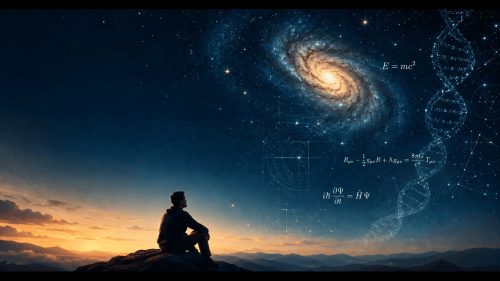

Can science and faith coexist, or does belief in God require setting reason aside?
What happens when we begin questioning the assumptions behind our worldview and exploring the limits of scientific explanation? Could a commitment to evidence and reason lead us to reconsider what we believe about God and the nature of reality?
Contents:
- Is It Rational to Believe in God?
- When Science Seemed to Have All the Answers
- Science, Philosophy, and the Assumptions Behind Our Beliefs
- When Personal Questions Became Impossible to Ignore
- What Does It Mean to Follow the Evidence?
Is It Rational to Believe in God?
What happens when you believe science holds all the answers but begin questioning the assumptions behind your worldview?
Science is associated with evidence, reason, and intellectual rigor. Faith, by contrast, is often viewed as something people embrace when reason falls short. But is that distinction justified? Is belief in God necessarily irrational, or can a commitment to reason lead someone to reconsider the worldview they once accepted?
These are questions that eX-skeptic guest Dr. Trevor Lohman knows firsthand.
A clinical research neuroscientist, professor, and author of God’s Eye View, Trevor spent years as a committed atheist. He believed science was the most reliable path to truth and regarded religion as an obstacle to clear thinking. Yet his journey from atheism to Christianity did not begin with a rejection of science. It began with a willingness to examine his own assumptions.
Does science rule out belief in God, or can reason and evidence lead us to reconsider what we believe?
When Science Seemed to Have All the Answers
Trevor’s confidence in atheism was rooted in his trust in science. With a background in cellular and molecular biology and a career in neuroscience research, he saw scientific explanations as more compelling than religious ones.
Over time, however, he recognized an important distinction: science is an exceptionally powerful tool for understanding the natural world, but it does not necessarily answer every question about reality.
Science can investigate how the brain works and how humans make decisions. Yet questions about subjective experience, free will, morality, and why anything exists at all also raise philosophical issues that scientific findings alone may not settle.
As Trevor reflected on these issues, he realized that his worldview rested not only on science but also on a philosophical assumption: that the natural world is all that exists and that science is the only path to knowledge.
This view, known as naturalism, is not itself a scientific discovery but a philosophical claim about reality. Recognizing this distinction led Trevor to ask whether the worldview he had long embraced was as rationally secure as he had once assumed.
Science, Philosophy, and the Assumptions Behind Our Beliefs
Trevor’s story challenges the assumption that scientific thinking and belief in God are incompatible. But does science rule out God, or are there questions about reality that require philosophical as well as scientific investigation?
Science is remarkably effective at explaining the natural world. However, science and naturalism are not the same thing. Science is a method for investigating the natural world; naturalism is the philosophical view that nature is all that exists. Scientific discoveries do not, by themselves, establish that nothing exists beyond the natural world.
We all evaluate the world through assumptions about what counts as reliable evidence, which explanations are reasonable, and what we consider possible. A skeptic might rightly ask a Christian, “Why do you believe in God? What evidence supports your belief?” Intellectual honesty also invites us to examine our own position: “What reasons support my view of whether God exists?”
Neither belief in God nor disbelief should be accepted or rejected simply because it feels intellectually respectable or culturally familiar. Both deserve careful consideration. Questioning our assumptions does not mean abandoning reason or accepting every religious claim. It means being willing to examine the reasons behind what we believe.
If God exists, the natural world would be part of His creation, and studying it could deepen our understanding of that creation. The fact that some scientists are Christians does not prove Christianity, but it demonstrates that scientific inquiry and religious belief need not be mutually exclusive.
When Personal Questions Became Impossible to Ignore
Intellectual questions are not always what prompt us to reconsider our worldview. Sometimes personal experiences, such as the birth of a child, lead us to reflect more deeply on the meaning of life, human nature, and the world we inhabit.
What makes human life valuable? Is love simply a product of biological processes, or does it point to something more? Is there a purpose to our existence beyond survival and reproduction?
For Trevor, these questions prompted a fresh examination of his worldview and led him to explore ideas he had once dismissed, including the possibility of a Creator and the claims of Christianity.
His journey toward belief was gradual. As he explains in his conversation with eX-skeptic, he began by considering whether there might be a creator, then whether an afterlife was possible, and eventually whether the story of Jesus was true.
Rather than arriving at a conclusion all at once, Trevor continued to investigate, reconsider his assumptions, and ask questions. His experience illustrates how personal reflection can open the door to exploring ideas that once seemed implausible.
What Does It Mean to Follow the Evidence?
For Trevor, the question was no longer whether science worked, but whether science alone could answer every question about reality. His journey raises a broader question: what does it mean to follow the evidence honestly, especially when it challenges beliefs we have held for years?
Questions about why the universe exists and whether moral truths are more than personal or cultural preferences illustrate why following the evidence sometimes requires philosophical reasoning alongside scientific investigation. Science can help us understand how the universe developed and how humans form moral beliefs. But questions about why anything exists at all, or whether some actions are objectively right or wrong regardless of what society believes, invite us to consider more than scientific observations alone.
These questions do not, by themselves, prove that God exists. They do, however, raise questions about whether a naturalistic worldview offers a complete account of reality.
Are you willing to examine the assumptions behind your own worldview with the same care you apply to the beliefs of others?
This question is not about reaching a predetermined conclusion. It is about approaching the search for truth with intellectual honesty and a willingness to reconsider what we believe.
For skeptics, that may mean questioning whether naturalism is the only reasonable explanation of reality. For Christians, it may mean engaging difficult questions rather than relying on familiar answers. For those still searching, it means allowing room to explore without feeling pressured to decide everything at once.
Trevor’s story does not prove that God exists. It illustrates how questioning long-held assumptions can open new possibilities for investigation and how a commitment to reason can lead someone to reconsider what they once believed.
In The Mystery of Reality: Dr. Trevor Lohman’s Story, Trevor shares his journey from atheism to Christian faith and how he came to see science and belief in God as compatible. You can also explore his book, God’s Eye View, for a deeper look at science, faith, and the search for truth.
If you’re wrestling with questions about faith, reason, and belief in God, explore the eX-skeptic Guide Is It Rational to Believe in God? featuring ten real-life journeys from former skeptics and atheists, along with reflection questions and practical insights to help you think more deeply about the questions that matter.
More questions? Read our blog Evidence for God from Science.
Explore our Guides
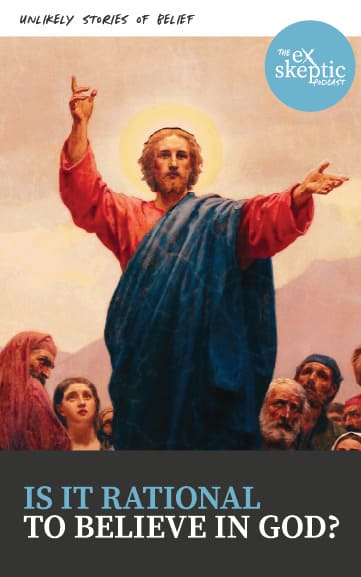
If you’re wrestling with questions about faith, reason, and belief in God, explore the eX-skeptic Guide Is It Rational to Believe in God? featuring ten real-life journeys from former skeptics and atheists, along with reflection questions and practical insights to help you think more deeply about the questions that matter.
eX-skeptic offers a safe and credible place to consider how and why skeptics come to believe in God and Christianity. This article is written for educational and exploratory purposes and is intended to encourage honest, thoughtful conversation.