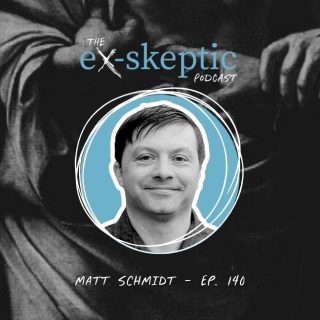

What if the questions that once pulled you away from faith could be the very questions that lead you back?
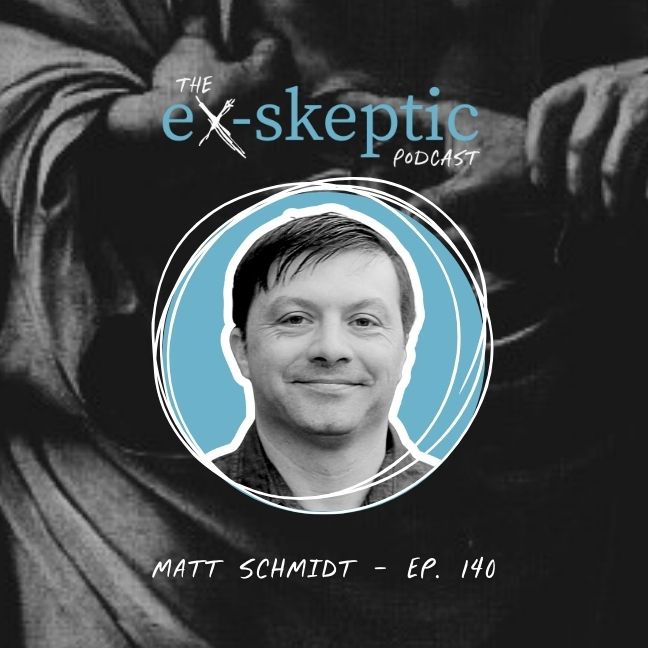
That’s exactly what happened to Matt Schmidt. As a naturally inquisitive kid, Matt felt the weight of questions that no one around him could answer — questions about science, origins, morality, and whether the Bible could be trusted. With no guidance or satisfying explanations, he walked away from Christianity and embraced atheism.
But the same relentless curiosity that distanced him from belief slowly began to unravel the foundations of his atheism. How do you get something from nothing? Where does morality come from? Why do humans care about meaning at all? Listen to what Matt discovered through his journey.
🎙️ Love the show? Support the mission and explore eX-skeptic merch here: https://ex-skeptic-shop.fourthwall.com/
Guest Bio:
Matt Schmidt is the co-founder and CEO of Engage 360, a ministry dedicated to helping everyday Christians share their faith with clarity, confidence, and compassion in everyday conversations. Matt holds a master’s degree in philosophy with studies in theology, apologetics, and biblical studies from Southern Evangelical Seminary.
Resources Mentioned:
Matt’s Resources:
• Website: Engage 360 www.e360m.org
Matt’s recommended resources:
• Alistair Begg, www.truthforlife.org•
R.C. Sproul on the reliability of scripture: https://www.truthnetwork.com/show/renewing-your-mind-rc-sproul/44894/?utm_source=chatgpt.com
Connect with eX-skeptic:
Website: https://exskeptic.org/
Facebook: http://www.facebook.com/exskeptic
Instagram: http://www.instagram.com/exskeptic
Twitter: http://x.com/exskeptic
YouTube: https://www.youtube.com/@exskeptic
Email info: info@exskeptic.org
eX-skeptic transcript
Ep. 140 Matt Schmidt
March 13, 2026
Matt Schmidt
00:00 – 00:23
What I started to struggle with, that’s the beginning of leading me back to God, was what is the nothing before the Big Bang? What is nothing? And how does nothing cause a universe? Eventually I got so unsettled that this actually isn’t reasonable. Most people were pretty settled that, oh, the Big Bang explains how you get a universe. And they were content stopping there. Well, I was not.
Jana Harmon
00:29 – 01:22
Hello, I’m Jana Harmon, host of eX-skeptic, where we explore unlikely stories of belief in God and Christianity. Before we begin today’s conversation, I’d love to remind you about a few things we have on offer at eX-skeptic that you may not know about. We’ve curated all our stories into playlists that address some of the most common objections, doubts and questions raised against belief. You can explore those playlists on our YouTube channel. We also have a conversational AI tool on our website and designed to help you find thoughtful answers to your own questions. Just visit eX-skeptic.org and while you’re there, you can help us tell more stories by making a donation or by picking up an eX-skeptic tee shirt or sweatshirt. We’d be so grateful for your support. And finally, if you’ve been encouraged by these stories, please rate, review and share this podcast. It really does help others discover us. Now to today’s story.
Speaker 1
01:23 – 02:20
This episode follows the journey of a perpetually curious mind, someone who questioned everything – not out of cynicism, but out of a deep desire to know what’s true. For Matt Schmidt, questions about science, origins and the reliability of the Bible first pulled him away from belief in God towards atheism. But the same inquisitive drive, his refusal to stop asking questions and eventually led him back again to the belief in Jesus Christ he had left behind. So much so that he has dedicated his life to help others know what he’s found. If you’ve ever wondered whether faith is reasonable, if your own questions have pulled you away from belief, or if you’re simply curious enough to keep asking and looking, this conversation is for you. I hope you’ll listen in. Welcome to the eX-skeptic podcast, Matt, it’s so great to have you with me today.
Matt Schmidt
02:20 – 02:22
I’m really glad to be around here with you.
Jana Harmon
02:23 – 02:31
As we’re getting started, Matt, tell us a little bit about who you are, the kind of work and ministry you’re involved with, and the things that you’re really excited about.
Matt Schmidt
02:31 – 02:51
Sure, yeah. Well, thanks for having me on. I’m very excited to be able to share and hopefully be an encouragement to others. So, my name is Matt Schmidt. I am one of the founders and CEO of a small ministry called Engage 360 and we focus on helping everyday Christians to share their faith in everyday conversation.
Jana Harmon
02:51 – 02:55
Wonderful. And you do have an advanced degree in theological studies, don’t you?
Matt Schmidt
02:55 – 03:02
Yes, yeah, I have a master’s in philosophy with studies in theology and apologetics and Bible from Southern Evangelical Seminary.
Jana Harmon
03:02 – 03:18
Thank you so much for coming on today and telling your story. Let’s get to the beginning of your story. Why don’t you talk to us about your world growing up. Where were your beliefs back when you were in childhood?
Matt Schmidt
03:19 – 08:03
Right? Yeah. I grew up in Nebraska, kind of probably what you might think of typical Midwest family, good work ethic, take care of others. I was taught immensely good values by my family, by my parents, very loving environment. I never questioned if I was loved or if I mattered or if I had worth. I did well in school and in sports and as I grew got involved in leadership activities. So you know, I was very satisfied with life. I didn’t have a lot of the challenges that maybe many people do. I didn’t have a lot of the felt needs that a lot of people do because I was pretty content with life. But I’ve always been really inquisitive. I’ve always been a question asker. That’s never changed. It still hasn’t today. And so we were in a mainline conservative but mainline denomination growing up on both sides of my parents’ families going back, I think were all in that. And so you know, we were taught the basics of Jesus and the Gospel probably. I don’t know if I would have heard it from phrased as ‘this is the gospel,’ but you know, we knew the basics and that was kind of what they had been raised in. But my sense of, in my memory, and I may also misremember a little bit because it’s going back a ways but I remember it being more something we just went and did every week and we did that till I was probably about 13 and then we stopped going. I had already begun asking questions at 8, 9, 10 that I remember the pastors not being able to answer and not really getting any good satisfactory answers to some of those questions. I don’t even remember all what they were. I remember some of them, but I remember having that sense and being told, you know, ‘Well, we just have to believe or we just have to have faith.’ And so I continued, I’d say, I guess living by Christian morals and my family pretty much the same and probably affirming the basics around Christianity. But we stopped going to church and I don’t know if that was necessarily a factor. But as I continued in my sort of natural skepticism, my natural question asking personality, I ended up, by the time I was at the end of high school, I would have called myself an atheist. It seemed like science did explain everything. Evolution explained all that we needed to, all the stuff that religion or God had explained now science had. And so I just thought, well, it doesn’t make sense. And I also had really asked a lot of questions about the Bible and primarily how do you know we can trust the Bible? And when I would talk to Christian friends, I think these are some of the questions I had even asked pastors earlier was if you’re saying we need to put our entire life and eternity in this book and what it teaches, well, how did you get it? How do you know it hasn’t been changed? And I never really got an answer to that question until right when I came to faith, which was three years later. And we can kind of talk more about that. But I didn’t really have any sort of understanding of how we can trust the integrity of the Bible, how we would know it’s God word. I got a much more circular answer of ‘Well, how do you know we can trust the Bible? Well, because it’s God’s word.’ And I would say, ‘Well, I understand you think it’s God’s word, but how do you know that?’ ‘Well, because it’s the Bible and that’s that the Bible is God’s word.’ And I would try to explain why I understand you’re asserting that, but how do you know that? That’s a different thing. And I would always get some form of a circular answer of ‘Well, we just have to trust it because it’s from God’ and it would just go around like that. So against the backdrop of not having the felt needs that many do for God, being fairly satisfied in many ways in life, having good morals, so being a generally moral person now, not near as moral as I thought I was at the time, as I see looking back, but relative to others and even many Christians that I knew I was more moral. And then having this idea that it’s either science or faith, all of that combined together, I just got to the point where I just didn’t think you needed God anymore. And so I was an atheist, I guess I would say not highly informed, not highly intellectual atheist, but just I don’t think we need God. I don’t think he explains what the Christians say you do and he does. And I don’t think they have any way to know what he actually said if he did.
Jana Harmon
08:06 – 08:36
Yeah, I think that’s a pretty common path, isn’t it? Yeah, it’s easy, it seems, to let go of the beliefs that you’ve been taught but haven’t been substantiated in any kind of substantive way by, even when you’re asking the questions, you’re not getting substantive answers. And then you, you turn and go, well, science, well, there’s science and they’re not giving explanations.
Matt Schmidt
08:36 – 08:37
Right, right.
Jana Harmon
08:37 – 09:01
And so I think it’s again, a common drift. And now when you’re moving in that direction and it seems like the intellectually honest thing to do, you’re still a moral guy, you’re still kind of behaving and acting well, you know, what you don’t believe and you know that you believe in science.
Matt Schmidt
09:01 – 09:02
Right.
Jana Harmon
09:02 – 09:20
But you said you, it wasn’t an intellectual atheism, but did you really look at what that meant or what did you understand the implications of, okay, I’m leaving this kind of God world behind of superstition, but what am I actually embracing?
Matt Schmidt
09:20 – 11:02
Yeah. So I guess I would say maybe it was an intellectual atheism in the sense that it was informed by do we need God? Does God explain what Christians, what followers of religion, say he does? Do you actually need him, or have we filled those gaps? But what, I mean, when I said it wasn’t highly intellectual, I wasn’t reading some deep philosophy, I wasn’t well versed in science. It was kind of more of just a probably a little bit more avid intellectual personality bent, applying basic reason to just what I had been presented by the world at that point. And so it was intellectual in one sense, but it wasn’t deeply intellectual like I was reading some great atheist philosophers or I was engaged in the debate between Christians and atheists or theists and non theists. I didn’t even know that stuff really existed. I was just ignoring, ignorant of what was out there. And I didn’t know people who really loved talking about this kind of thing. So I thought I was just kind of this oddball. I thought if you, if what Christianity is, if what religion is, is you shut your brain off to believe a set of things and then you can turn it back on to go do math and science and you know, history. I can’t do that. I’m going to have to be consistent with all of my life as best I can. Now, again, looking back, I was not as consistent as I thought I was, but I wasn’t trying to be dishonest. I wasn’t trying to deceive or whatever. It was just how I thought things worked. So I was just trying to pursue it.
Jana Harmon
11:03 – 11:19
No, you’re trying to be consistent in your worldview. And if it doesn’t make sense, if it’s not supported intellectually, then it’s not worthy of belief. And, and I think I’ve heard that a good bit. I wish I could believe, but I can’t. You know, it’s just not there. There’s not enough solid evidence for me to believe.
Matt Schmidt
11:19 – 11:19
Right.
Jana Harmon
11:20 – 11:39
This is a, maybe an unusual question, but as you were leaving all that behind and Jesus is the center point of the Christian religion. Did you have an opinion about who Jesus was at the time when you were like, okay, I’m an atheist, who was Jesus? Who would you have said?
Matt Schmidt
11:39 – 13:54
Yeah, so I knew he was important, but I think I had adopted again, just picked up, like a dog picks up fleas. I had just picked up this idea that the most important thing about Christianity was being moral and Jesus was this ideal moral exemplar. There was other stuff that went with it too, but I thought that was what was most important. And I thought if I would. I don’t know if I was ever explicitly asked at the time, but I think what I would have said if somebody said, ‘Well, what is Christianity about? Like, what does it mean for someone to be saved? How does that happen?’ I think I would have said something along the lines of, ‘Well, Christianity teaches that good people go to heaven because they deserve it and they’re following the example of Jesus. And bad people can maybe still get a chance if they put it all on Jesus and turn their life around, then they get a go too.’ But I didn’t understand the significance of the actual life of Jesus, his death, his resurrection, you know, what I’d say now understand is core to the gospel. I thought that was just a story that went along with it. And, you know, some people listening to this may have had this same view. I don’t remember ever being explicitly taught this, but I had developed this idea that there was real history, real historical events, like Abraham Lincoln was the 16th president of the United States, things like that. And then there were fairy tales completely made up. And I thought Christianity was something in between those two. Now I don’t even know what that category would be at this point. I had never explicitly developed this understanding of reality. It just something I had adopted. So I thought they were true stories probably in a some sense, but that there it was more the moral truth of them that was most important. And I don’t think I would have denied that Jesus was a real person by any means. But I didn’t understand how much of a big deal him being a real person who actually did miracles, actually died on a cross, actually rose three days later. I didn’t understand at all the significance of those things.
Jana Harmon
13:54 – 14:36
So Matt, you had kind of left the Christianity that you had grown up with behind the tradition of the ceremony of it or whatever. But you had moved into this more intellectual, science driven sense of reality. Talk to us about what that path looked like. It seemed like you were fairly happy and satisfied in your life. It’s not like you were looking to sew your oats, right? Or live far from God. You were, you were actually just moving in a way that made more sense to you in your life. So what, what did that look like?
Matt Schmidt
14:36 – 19:30
So, I mean, mostly it looked like just living life, being a generally good person. You know, I played intramural sports. I did fairly well in school. Not incredible, but fairly well. You know, I was friends with a wide range of people. I could be friends with almost anyone, whether they were Christian or not, whether they were religious or not. It wasn’t a barrier to friendships with people, but I probably just gravitated towards people who were just enjoying life. I didn’t drink, I didn’t smoke. I didn’t do the things a lot of people do to try to find meaning or to deal with hurts they were dealing with because I didn’t really have those. So it was really just that. But I think sort of a Romans 1, the first part of Romans 1 was playing out in that I continued questioning. I didn’t just settled and okay, now my questions are gone. I’ve always been and remain that questioning type personality. So what I started to struggle with, that’s the beginning of leading me back to God. And it was probably not too long after I would have started to call myself an atheist was what is the nothing before the big bang? I thought the big bang had settled, ‘you don’t need God.’ I guess I held to the general what you’re taught in high school, early college-type understanding. And what I started to struggle with was well, what is nothing and how does nothing cause a universe? And what does that even look like? What is the process there? And this shows where I’m a little bit odd and maybe the more skeptic intellectual types listening will appreciate this. But I would think about this a lot, Now, I wasn’t so overwhelmed with it that I had to find answers. And I didn’t know there were people that would even be able to have these conversations. So I was living life, just doing things, going to school, working, playing intramural sports, being friends, you know, hanging out. But in the backdrop I was often thinking about this big question, like what is nothing and how does it cause the universe? And so I remember I would drive on some of the one way streets in our college town late at night because I wouldn’t be able to sleep because I was trying to imagine what is nothing. And I would get this big black expanse in my head and I would know, no, that’s not nothing. I’m still just, I’m making a universe, but without stars, without light, that’s not nothing. And then I’d think, okay, make a big white expanse. Well, that’s not nothing either. That’s just light there. That’s still something. And eventually I got so unsettled that this actually isn’t reasonable, this isn’t intellectual. And I had studied a little bit, just enough to know there weren’t really people answering that question of what’s the, before the Big Bang, where did it come from? Most people were pretty settled that, oh, the big Bang explains how you get a universe. And they were content stopping there. Well, I was not, I was still wrestling trying to figure that out. And in the backdrop was understanding morality is really important. And I wanted to ground a real objective morality. Now I couldn’t have maybe even put it in that term at the time, but I thought no, morality is a thing that’s binding for everyone. And I started to really struggle with how can you actually ground that on atheism? And I knew that probably the best you could get was if for society to exist and function well, most people have to be moral most of the time, otherwise it’d be chaos. But you can’t actually say everyone has to be moral all the time or else, because there is no ‘or else.’ It’s just whatever happens. And in fact, people who violate morality on a naturalistic scale, they actually can succeed and thrive at the expense of everyone else. And I didn’t have a way to say that was objectively wrong. It was just, well, but you’re risking the downside. But as long as you’re willing to risk the downside, go for it. Because there’s nothing actually wrong about it. It’s only inconvenient for others or problematic if we all started living like that all the time. But short of that, you couldn’t really ground anything further. I don’t think attempts at grounding a true objective morality, I don’t think they actually work. And I didn’t think so then, and after further study, I don’t think so now. So those two facts – how did you get a universe from nothing and where do we ground this actually for everyone a morality that can’t be violated. Those two things really drove me from atheism to something probably closer to a deism eventually, even though, again, I wouldn’t have even known that word at the time.
Jana Harmon
19:30 – 20:35
So you were really troubled, open to a better explanation than what you were being given in atheism that the natural world is all that exists and that nothing is no thing. And it’s hard to get something from no thing at all. It is interesting how some tried to define and finesse the word nothing to be something. Right, but that’s another conversation. So you said earlier that, you weren’t really aware of these kind of intellectual conversations going on. It was obviously something, you were driving around at night being troubled by these big ideas and these concepts and, these are really deep questions that have huge implications. Right? So how did you start making your way forward in this? Was it some kind of independent study? Did you find podcasts, books, people? How did you wrestle with these questions in a meaningful way?
Matt Schmidt
20:35 – 24:06
Yeah, it would have probably been really helpful if I did. But no, unfortunately I didn’t. I was just kind of wrestling through and I went from, okay, I think it would have been pretty early. Probably I was 19, probably my second year of college that I would have really started to deal with, okay, there has to be something that caused the universe. But what drove me past the deism was just the sort of analysis that if there’s a God powerful enough to create a universe that ends up making humans who can then question that universe, that’s probably not an accident. He probably didn’t do that on accident. It’s probably on purpose. And if it was, that explains a lot more why we have this sense of morality that we’re supposed to be following because it comes from God, the one who made everything. And so I would have went to something like a theism of some simple flavor of God created us and gave us a moral purpose in life. And that’s why we all have to obey the morality, because it comes from God. And again, because I thought I was a good person, that was enough. Now I can make sense of it. I can explain how do you get a world or how do you get a universe, how do you get a world? How do you get humans with this sense of meaning and this sense of morality? And so that was good enough for a while, but continuing to not just wasn’t running from God, I just didn’t know all that was there to be pursued. I was just kind of following truth as best I could without it ever being the main focus of my life, but it kind of always there. And I think as I would take a step, God would prepare the path, prepare the foundation for the next step, and then I would take that step. And I think God was just patiently guiding me along the way, far more than I ever understood at the time. And so eventually the whole idea of the issue of morality and of how do we live started to take on, well, if God creates us and creates us for a purpose, then he would probably be able to tell us what that purpose is. And so maybe there’s something more to this religion thing than I understood before. And so then at that point, I would say I really probably started to look into religion a little bit more. But again, it was pretty crude and pretty simple in that my main understanding of most religions was that they all had some role for Jesus. And pretty much every. Everything I knew of. And a lot of people even who weren’t Christians looked at Jesus as this ideal moral example. And because just being a good person, morality was driving a lot of my thinking, I came to see, okay, Christianity, which I didn’t know what I even meant by that at the time, other than not what I had been sort of experienced in some ways not formalized, but this idea of we just need to follow Jesus’s example. I think that’s what I would have said Christianity was. So I would have started calling myself a Christian, meaning, I’m going to try to live by Jesus example, which I was mostly ignorant of at the time as well. So it’s kind of funny that I did that. But that was sort of the path, I guess, from atheism to deism to theism, to saying I was a Christian over about three-ish years. But I didn’t understand the gospel and I didn’t understand the significance of Jesus just yet.
Jana Harmon
24:06 – 26:02
Wow, that’s so interesting because you mentioned Romans 1 earlier. And so God basically says that man is without excuse because all you have to do is look at the creation. And it’s hard to explain without a creator. And then it says there’s our conscience, that we all know that there’s some kind of moral right and wrong. It’s in the heart of every man. And so you’re moving this direction. And then it talks about Christ. So you, you were moving this direction. Obviously, I find it a little bit ironic that you weren’t like, you weren’t pulling out Aristotle. You weren’t like studying the Kalam Cosmological Argument for the existence of God. You weren’t, you know, all of the things. You weren’t tapping into those. This was just a man with basically reason and revelation together. From what you were able to gather without, you know, special sources and intellectual journeying. It’s just, it’s just intuitive. Right. I mean, I think that we are built in a way to try to make sense of the world. Yeah, and as you were saying, it’s almost an argument for God, that God has designed us in a way that we can discover things from the things that we see and the things that we feel and intuit. And so that you were taken along this journeying, just kind of you and God, in a sense, as you were moving along from atheism to deism to theism, and then kind of falling on this person of Christ not understanding it fully.
Matt Schmidt
26:02 – 26:02
Right.
Jana Harmon
26:02 – 26:16
But what a beautiful kind of path. And I love the fact that you were open to that journeying, trying to make sense of reality and of yourself. So then, so then what did you do with this person of Jesus? Yes. What did you do with that?
Matt Schmidt
26:16 – 31:40
So, well, I have my wife to thank for that. So I would have started calling myself a Christian. I would have thought, I’m living, I’m following the example of Jesus. I wasn’t ashamed of saying Christian now. I don’t know that I was like out there telling everyone, but like, I was fine with it. It. My wife had a different way that she came to Jesus and it was very passionate. It was much more based in the fullness of her being of not less intellectual, but much more deeper, much deeper and much more passionate. And I knew her for several years before she was coming to school where I was attending and I knew I was interested in dating her. Hadn’t really dated much, was really, again, even as an atheist, I knew that I wouldn’t want to date anyone unless I was going to marry them. And so I knew that she was someone who was very interested in dating and pursuing. But I also knew that she had a Christianity that was different than mine. Even though I had said I was a Christian, I knew there was a difference. And I would summarize it as I knew she believed Christianity in a way where it gave meaning, it gave purpose to her life and she was never going to leave it. I wasn’t looking to leave it, but I was trying to answer the questions of reality as best I could. And I thought Christianity was the best explanation for how do you get a universe? How do you get order in the universe? How do you get design and biological life? How do you get objective morality? What is the purpose that we’re trying to live towards? How should we treat one another? I thought it answered all of those questions better than anything else I was aware of. But as we’re finding out, I was somewhat ignorant. So I’m not sure how much weight all that carries. But it was certainly the best explanation that I knew of. And I knew that I needed to understand it and hold it in a different way than that if I was going to be right in asking her out. And so I don’t know how much I had prayed before that I think I had some, I would talk with God and I don’t know that we even need to make a massive distinction because I would just, in my head I’d be having a conversation and I would involve God in it. Not really having a great model for what that looked like, but I would just be doing this kind of as I went about life, you know, at times somewhat regularly. But I remember fairly explicitly praying in a way I didn’t normally I would at least say that. And I remember asking God something along the lines of God, I think this is true. I think Christianity is true and I think you’re real. But I need to know in a way that I’m never going to leave it if I’m going to ask her Erica out. I wouldn’t be right to do that. So help me to know some way that I can be sure about this. And I didn’t get some light bulb immediate thing that happened. But as I was driving, I think it was only a few weeks later, I started flipping through the radio. This was back when CD players were a big deal, but I would listen to the radio a lot still. And so I’m flipping through the stations and I come across this Scottish accent that just catches me. So I start listening. Well, it ends up it was a pastor named Alistair Begg, who I didn’t know anything about at the time, but I loved his accent, so I just kept listening. And something that he said, I think opened up my understanding that it’s not about being a good person. There is no such thing relative to God. And he’s used a quote that I believe may have been what he shared at that time of that there’s two types of people who miss out on what God offers through Jesus. Those who think they’re so good they don’t need it, and those who think they’re so bad they don’t deserve it. And I was certainly in the first category. I was in the ‘too good to need it’ category. Not that I thought I was perfect, but I thought sin. And this is another thing that, you know, I’ve learned is so important. What does a term mean? You might intend one thing, you might know, but when you use the word, you have to think about what does the other person know? So what I knew is I wasn’t a sinner because I didn’t murder, I didn’t steal things of great value. You know, I hadn’t abused women or anything like that. So I wasn’t a sinner. I just wasn’t perfect. Well, I didn’t know that those are the same thing. And so something in his sermon, I think, put those pieces together for me. And it hit me one day, shortly after that. Again, timeframe is fuzzy because I didn’t know how significant this was at the time. But something hit me clearly that. Wait a second. So even if it was just me, Jesus still would have had to die. I’m not in some special category of goodness where Jesus is necessary for some people, but then there’s other people that it’s kind of like more of a bonus, but you’re kind of doing it on your own. And that was what I really needed to understand, a core aspect of the gospel that I just was completely ignorant of. And so that element really change things for me.
Jana Harmon
31:40 – 32:15
And that is a huge piece of it, isn’t it? I think that’s a very, again, a very common perspective. If you’re just good enough. Yeah, if you’re just good enough. I’ve heard it said and kind of this provocative way. Good people don’t go to heaven, forgiven people do. And it’s coming to that place of felt need, It sounds like that’s of recognition that, no, you’re not perfect and you never will be. Right. And that you need Jesus in order to.
Matt Schmidt
32:16 – 32:17
Receive what he offers.
Jana Harmon
32:17 – 32:40
Yeah, so you were in your car, you heard that beautiful Irish dialect, but it really penetrated your heart it sounds like, in a way, gave you an awareness and understanding that maybe there was a door into something deeper, something more meaningful, something that you wouldn’t leave.
Matt Schmidt
32:41 – 33:40
Yeah. And I do remember then saying, like, okay, at the point I realized I put it together, it wasn’t at the moment of hearing the sermon, it was some period of days later, but it was close to it. I remember thinking that, ‘Okay, wait, Jesus would have had to die just for me.’ And I remember saying something like, ‘God, I recognize, like you had to do this for me. It’s not just something that’s for bad people, but that I’m in that category and need it too.’ And so that was really significant. And was not only when, now I wouldn’t have said, ‘Hey, look, now I’m saved.’ I didn’t even know there was a difference. I was just pursuing what seemed like truth as best I could. And so I didn’t understand how significant that was at the time. But looking back, I’d say that’s probably the point I was saved. I trust God in his sovereignty knows how all that works together.
Jana Harmon
33:40 – 34:09
And I would imagine that you probably started engaging in the Bible in a pretty serious way. Now, earlier in your story, one of the reasons why you rejected belief is because you didn’t know if the Bible was believable. You weren’t given good answers to believe that this was historical reality along with all of the other…maybe had some moral truths to it. But how did you reconcile that issue?
Matt Schmidt
34:10 – 38:25
So, two things. One, I got a study Bible and I was just looking through it and I decided I was going to read it. So I was reading cover to cover, just like you’re supposed to read a book, proving my ignorance. Once again, I didn’t know. I thought it was just a book. You know, you read. You start at the beginning and you read till the end and you hear the story. But early on I started flipping through the whole entire thing and I saw these maps. I thought, oh, this is interesting. Like, these are maps of real places. And then there was a timeline or a series of timelines in it, and it showed the Hebrew people, the Jewish people and their timeline up against the Egyptians and the Mesopotamians and all of this laid out. And I can’t remember if I said this to Erica, who I think I would have been dating at this time, or if it was someone else, but I remember one day, like just showing him, like, ‘Look, did you know this is? This happens in real history just like other things.’ And whoever it was, I told that, they’re like, ‘Well, what else would it be?’ And I said, ‘I don’t know. I thought there was some special category of Bible history that’s somewhere between made up and real history, whatever that is. I don’t know. I don’t know.’ I never got that explicitly, but that’s what I had. So it just shocked me. Wait, this really happened? And this is the Bible’s claiming to say things about real people who existed in real places. And that sounds probably really foolish in a sense to many people, but that’s where I was. And so I started reading the Bible, started listening. I was listening pretty regularly to these sermons. And then I must have been driving further one time relative to most often when I listened to Alistair Beg and I left the radio on after his program and I heard a guy named R.C. Sproul. And in about 30 minutes he dealt with one of my biggest questions and objections to Christianity, which was the reliability of the Bible. And what he helped me see was, and this was all I would have needed one Christian to know. I thought it was a game of telephone. I had even made that explicit. I said, if it’s a copy of a copy of a copy, you know, hundreds or thousands of times, how do you know there haven’t been changes? How do you even know you have what they said and wrote 2000 years ago? And no one ever answered that. And when he lays out the basic manuscripts. And I wasn’t blown away by, oh, the number of manuscripts or anything like that. It was merely that you went from ancient Greek into contemporary English or French or German or whatever. You pick your language, you’re going from early manuscripts to the current language that you’re translating into. Well, that avoids the whole problem I saw, which was this idea of telephone and the minor changes over thousands of years that could have made a very different product in the end than it began as well. That was just all resolved. And so what shocked me was, okay, if it’s that easy, how did nobody know that answer? It wasn’t even hard. You don’t have to get an academic degree. You don’t even have to be an academic intellectual personality type. That’s a basic thing. Literally every Christian could know how to answer, at least in a simple way. And I think I would have been satisfied with the simple answer. And once I heard that, then life was totally different from that point on. I started ordering every book I could. I started pouring through those, you know, just tearing them apart and really finding out. Okay. I had done in a very simplistic, crude, meandering way. Something that people are talking about all over the place I just was ignorant of. But I found out I wasn’t alone. There were a lot of Christians that were pretty committed to Christianity that were just as ignorant of some of these answers. And so my life’s passion became, okay, well, let’s teach the church how to answer these questions. Let’s teach Christians how to answer these questions because they’re really relevant. And I thought, man, once everyone finds out what I found, they’re going to be just as excited as I am. And as probably again, any of your more apologist intellectual types find out, people are not as excited as we are about those things.
Jana Harmon
38:26 – 38:35
Yes. So your enthusiasm actually, it sounds like led you into a graduate degree once this door was opened.
Matt Schmidt
38:36 – 38:36
Yeah.
Jana Harmon
38:36 – 38:51
And you wanted to go full bore into answering these questions, understanding more philosophy, theology, apologetics. Is that what happened, is that you got so excited about what you were finding?
Matt Schmidt
38:52 – 40:59
Yeah, yeah, I definitely took a turn that was very unexpected, but I was just so passionate about this and clearly had a kind of a natural gifting in this area. And I knew this is something I should pursue. And so I went and visited Southern Evangelical Seminary and Westminster. And everything about it affirmed seemingly that Charlotte, North Carolina, and Southern Evangelical Seminary is where I needed to go. And my wife was on board. We went and visited and we agreed this is what we’re going to do. She had a year to finish up school. I had finished a year before her. And so I just worked and she finished school. And when, when she graduated that summer around the Fourth of July, we packed everything we owned into a trailer, sold the little house we had bought, and drove halfway across the country, 1200 miles from anyone that we knew. And I didn’t have some great plan of, here’s what I’m going to do, I wasn’t going to start a ministry. I wasn’t going to become a pastor. People would ask, what are you going for? And I said, I’m just going to go learn and see how I can serve the church. And that’s it. They said, ‘Well, what are you going to do with it?’ I said, ‘I don’t know that I’m going to do clear, significantly, anything with it. I just want to learn and be available to see what God can do.’ And that was it. There was no real plan beyond that. I figured he would show us if there was something. And so we moved. And again, that was the major change in the course of my life. Really beginning to dive deeply into apologetics and then integrating philosophy and then really focusing more on philosophy. In the end, maybe a balance, but you know, doing the degree in philosophy instead of apologetics because I thought that just really helped round out a lot better and made you a much better thinker and therefore a better apologist. But yeah, so that was a change. And then of course, it’s changed from there, but that’s how I ended up into the apologetics endeavor. And really, I’d say beginning to robustly live at least a more complete Christian life was because of that.
Jana Harmon
40:59 – 41:43
That’s beautiful, though. Yes. The way that it’s just a step at a time, isn’t it? Just a step at a time. And now look at you. You are 22 years later with a ministry and he has given you so much. And through all of your study, philosophy, apologetics, theology, you’re sitting here as a representative of someone who’s saying, you seem to be rather satisfied that what you’re believing is intellectually satisfying. Yes, it’s morally satisfying. It is existentially satisfying. Gives you the life that you’ve always wanted in so much so that you are going and helping others to know it and to talk about it.
Matt Schmidt
41:43 – 41:43
Right.
Jana Harmon
41:44 – 42:10
So my question for you is, how is it or why is it? What does the Christian worldview offer that is so comprehensive that it seems to click on all cylinders, that is that it seems to provide the most fully orbed view of reality as compared to other worldviews.
Matt Schmidt
42:10 – 45:37
Yeah, yeah, that’s a great way to put it. And you know what? I’ll share. Others may have said as well, I doubt these are unique thoughts like nobody’s ever thought them. But what I came to see pretty early on was that there were really two primary unique aspects of Christianity. One is that every other religion or system, sort of system of wisdom living was about what you do to be acceptable to God, to get to God, to become part of the divine, to become part of the one, whatever system it is. It’s really all about what you do to get far enough or to get all the way. Where Christianity is about recognizing and admitting that you have no hope on your own, on your own, you can do nothing to earn, to merit your salvation, to get to God. But God knowing that and desiring your good, ultimately came down, condescended to us to do for us what we couldn’t do for ourselves. That’s a very unique thing in the world of religion and wisdom living, philosophy, whatever you’d want to say, life philosophy. And so I knew that a little bit about that contrast that I really began to appreciate more and more this distinction where Christianity and the simple way I have heard it said is that, you know, every other religion is about what you do, Christianity is about what’s done, or there’s various formulations of that same concept, but that’s a really unique part of Christianity. The second is that Christianity is the most historically grounded and both verifiable or falsifiable religion that there is. Other religions make historical claims. The difference is that you pretty much have to take their word for it. There’s really no other way to authenticate it other than the claims of the individual. And most every religion that’s based on some kind of revelation is that way or wisdom philosophy living is just more divine wise teachings that they’ve learned in some form. But Christianity is unique and distinct in that it’s saying no, it’s about this person of Jesus who comes on the tail of a number of other historical events and prophecies talking about this coming one who would be the Messiah. And these events in the life of Jesus were largely public events. His miracles were public, his teaching was public, his death was public. His resurrection was at least fairly public. It wasn’t just one or two people in isolation. It was hundreds. And then the disciples, when we think about their ministry that was largely public, they were publicly teaching these things about Jesus. They were sometimes publicly doing miracles. And so Christianity is a religion that would be absolutely simple to falsify because it’s making objective claims about real historical events in real historical places. Christianity is just so uniquely historically grounded and we massively underappreciate that this in the church today. And this is where faith is not, ‘You just believe, you just choose it you just believe it anyway.’ It is overwhelmingly grounded in history.
Jana Harmon
45:37 – 46:54
Yeah, that’s beautifully stated. Thank you for that, Matt. Yeah, I’m sitting here thinking about your journey, especially as a skeptic, and you were just making your way on your own, just kind of you and God just taking steps forward. And you’ve mentioned a time or two if I would have heard or if I would have known or if someone would have just showed me or told me, you know, perhaps you wouldn’t have gone through the journey that you did, but perhaps, you know, you’re stronger now because of the journey that you’ve been on. And you know what it feels like to be a skeptic, to have those big questions, to have them unanswered, to be searching on your own. And I’m sure that there are some people listening to our podcast and they are like, wow, I wish I knew, you know, that I have these big questions. I just don’t know where to turn. I don’t know where to go. I don’t know the first thing you know, I don’t know about Aristotle. I don’t know the people that you’re talking about. I don’t know what apologetics means. And just, you know, where can someone just start or even dive in fully?
Matt Schmidt
46:54 – 49:31
So I think we overcomplicate it in the world of apologetics and philosophy in that in the end, it’s really all about, who is Jesus? That’s the question that matters before any other question really matters very much. There may be some foundational things that lead to why it makes sense to even ask that question. So something like the general need for theism. And there are some who are atheist, where it does make sense to get them to theism is possible or reasonable before. But for the most part, most people are at a point where the real question is just, who is Jesus? And if you know how to present that. If you’re either a Christian who’s wanting to be prepared, and this is what our ministry does, is trying to prepare just the everyday Christian to be able to talk about these things in everyday conversation. If you can answer really four very basic questions, How do you know Jesus is the way? He rose from the dead. How do you know he rose from the dead? Eyewitness testimony, the apostles. How do you know you can trust them? A variety of reasons that their testimony is trustworthy – willingness to suffer, willingness to die, telling embarrassing details, things like that. And lastly, How do you know what you have, what they wrote, and knowing just basic of how we get a modern translation of the Bible and the basic ideas of the manuscript tradition. If you can answer those four questions, you’re actually ready to talk to most people. And very rarely are you going to have to go a lot beyond that if you know how to keep the conversation around those things. Because it’s really all about who is Jesus? Once that’s settled now we can start to really dive into the other things. But the only reason someone even questioned their view of, say, even something like evolution, not that they even have to reject it, that’s a sort of separate discussion. But the only reason for a secular naturalist person to do that is if they’re first convinced that something else is true. We can bring evidence. And there are times in conversations where I think, oh, it’ll be helpful for this person to give some of the evidence for design and the implications of information in DNA, things like that. It’s very compelling. But if they come to understand Jesus is who he actually is, that will give them a whole new way to look at, wow, maybe a lot of this is different than I’ve assumed. And so we don’t need to feel compelled, like, we need to learn the answers to the hundred most difficult questions or even the five. If you know how to say Jesus was a real person who actually did miracles, died on a cross and rose three days later, and we have what he said and did recorded in a secure way that’s been passed through history. You’re ready.
Jana Harmon
49:31 – 49:58
Yes. That is really wonderful advice because it really is all about the person of Christ, whether it’s for the Christian to know for themselves or to share Christ or for the person who’s interested in Christianity, because obviously Christ is the center of Christianity. So I would imagine that both skeptic and Christian can come to your website. Can you tell us a little bit about that?
Matt Schmidt
49:58 – 50:36
So what we’re primarily doing is focused on, yes, serving the church. We offer training to churches. But also we’re working on more and more online ways that we can engage people. Our ministry is called Engage360 and our website is e360m.org people could go on there, learn more about what we do, and reach out to us. We have a small group study. We have some other things along those lines. And then we’re working on these various online studies and an interactive online community. So if they go there, they can find out or access and reach out to us about whatever they might be interested in.
Jana Harmon
50:36 – 51:26
What a pleasure it is to have met you, Matt. We met a couple years ago, but just to hear what God has done in and through you is truly extraordinary. I’m so grateful that he led you along that pathway using your own natural skepticism and question asking to ask enough questions. Because questioning, yeah, never, never, never.d…truth doesn’t fear question. And there’s such a deep well within Christianity and the question of God but it’s so rich and deep and satisfying and it looks like you have found that really nice, deep, substantive place to rest so thank you so much for coming on.
Matt Schmidt
51:26 – 51:44
Thank you for your platform and what you do and putting these stories out and, you know, being encouragement to people and sharing the hope that we have. And yeah, I have so much to be grateful for. And God was so good to me even when I wasn’t really being all that serious about him, he was being serious about me.
Jana Harmon
51:45 – 52:59
What I love about Matt’s story is how his curiosity never quit. His questions led him away from God for a time, but ultimately they brought him back to the one who best explains reality, morality and meaning in Jesus Christ. Matt’s journey reminds us that faith isn’t the absence of questions. It’s where honest questions finally find their resolution in solid answers. If this conversation raised questions for you, we would love to connect you with one of our former guests. To connect continue your exploration of doubts, email us@info skeptic.org and we’ll get you connected. You can also visit our website to ask questions again with our new conversational AI tool that will guide you to stories and relevant information that might help you along your journey again, that’s on our website at eX-skeptic.org Special thanks to our producer, Ashley Kelfer and to the C.S. Lewis Institute podcast network for their partnership in helping us share these meaningful conversations. I’m Jana Harmon and this is eX-skeptic, where we explore unlikely stories of belief. Join me next time for another journey from doubt to belief.