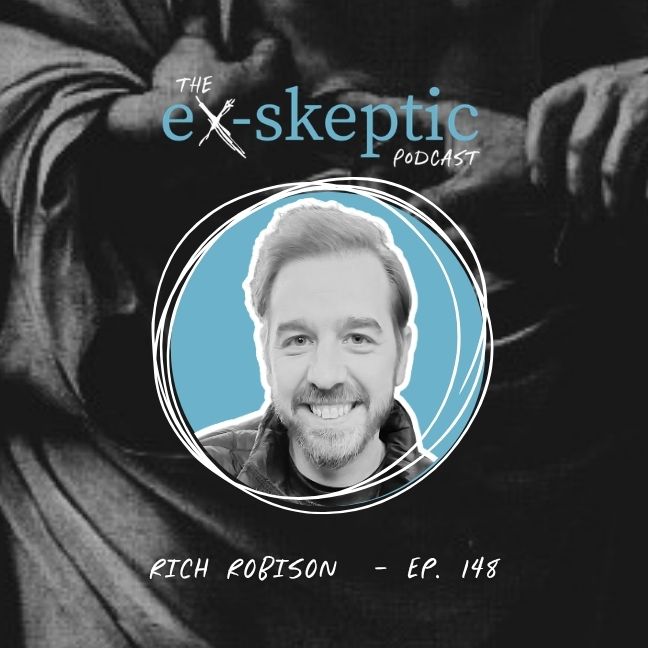

What happens when anger, disappointment, and painful family experiences shape your understanding of God?
For Rich Robison, faith wasn’t something he was searching for. Raised in a fractured home and moving 26 times before graduating high school, Rich eventually rejected God altogether. His anger toward his earthly father became anger toward any heavenly Father, and atheism seemed like the obvious conclusion.
But an unexpected encounter during a concert changed everything.
What followed was a journey through different world religions, hard intellectual questions, and a growing fascination with the person of Jesus. Along the way, Rich discovered that Christianity’s message was unlike anything else he encountered, not a story of striving to reach God, but the story of God coming to us.
Want to support this channel? Tax-deductible donations available here: https://givebutter.com/CB6WoH
Guest Bio:
Rich Robison blends engineering leadership, entrepreneurship, and faith. For the past two decades, he’s been navigating the software industry through tech companies big and small. A serial cofounder, Rich has helped launch multiple companies with successful exits. He sees his work as a mission field in itself. Based in Northern Colorado, Rich has been married for 22 years, and he’s the proud dad of two daughters, Abby and Chloe, and the owner of three dogs, Porter, Stout, and Hefeweizen. 2026 year marks his 30th spiritual birthday!
Resources Mentioned:
Rich’s Resources:
• LinkedIn: https://www.linkedin.com/in/richrobison/
• Email: rich@richrobison.com
Connect with eX-skeptic:
Website: https://exskeptic.org/
Facebook: http://www.facebook.com/exskeptic
Instagram: http://www.instagram.com/exskeptic
Twitter: http://x.com/exskeptic
YouTube: https://www.youtube.com/@exskeptic
Email info: info@exskeptic.org
Chapters
00:00 The Moment I Knew God Was Real
00:31 Introducing Rich Robison
01:49 Technology, Faith & Studying Scripture
03:42 Growing Up in a Broken Home
05:23 Why Religion Didn’t Make Sense
06:40 Anger at God & Becoming an Atheist
08:21 Does Atheism Require Faith?
11:50 Searching for Joy & Fulfillment
13:15 An Unexpected Encounter with God
16:21 When God Reached Out First
17:15 Searching Through World Religions
19:05 Why the Baha’i Faith Fell Short
21:30 Why Jesus Stood Apart
23:00 Seeing the Power of Prayer
25:00 Finding Freedom from Addiction
27:00 Wrestling with Christianity’s Exclusive Claims
35:06 What Makes Christianity Different?
37:45 Suffering, Forgiveness & Breaking the Cycle
45:04 How Faith Transformed Rich’s Life
49:00 Finding Peace & Advice for Skeptics
eX-skeptic transcript
Rich Robison
Ep. 148, July 3, 2026
The Moment I Knew God Was Real
00:00 – 00:25
RICH ROBISON: I went out of the concert, I laid down on the grass, I looked up in the clouds. And it’s very difficult to explain this, but I felt a presence, right? I felt a presence like I’d never felt in my life. And it just. It’s like it almost overtook my body and overtook my mind. And in that instance, I knew that there was a God. I knew that he loved me, and I knew that he wanted me to follow Him.
Introducing Rich Robison
00:31 – 01:48
JANA HARMON: Hello, and welcome to eX-skeptic. I’m Jana Harmon. This is a podcast featuring unlikely stories of belief conversations with former skeptics and atheists who reconsidered Christianity and came to believe in God and the person of Jesus Christ. Whether you’re exploring faith for yourself or seeking to better understand someone else’s journey, I’m glad you’re here. What happens when your understanding of God is informed by difficult life circumstances? Exposure to different religious ideas can also blur the picture of God even more. And for many thoughtful skeptics, the question becomes not whether God exists, but who Jesus truly is.
Today’s guest, Rich Robinson, brings the mind of an engineer and entrepreneur to those deeply personal questions. His story traces a search for truth through disappointment, competing worldviews, and surprising events. Along the way, he begins to see that the God he once questioned was not distant or indifferent, but present, and how everything in life makes much better sense through belief. Here’s my conversation with Rich, and I hope you’ll come along. Welcome to eX-skeptic. Rich, it’s so great to have you with me today.
Technology, Faith & Studying Scripture
01:49 – 01:51
RICH ROBISON: Thanks for having me, Jana. I’m excited to be here.
JANA HARMON: I’m excited for you to be here as well. I’d love for our listeners to know a little bit about you. Can you tell us a bit about the things that you’re interested in, the kind of work that you do?
RICH ROBISON: Yeah, sure. So for work, I manage technical teams. I’ve been in the tech industry for several decades. For fun, my wife and I go to way too many concerts. That’s the budget we always blow every year. But I also really love doing technical projects for the kingdom. I’m always looking for ideas of partners. So if you’re listening and you want to partner up on something, reach out. My wife and I also teach marriage classes because we’re very passionate about marriage. Let’s see, I’m halfway through a Bible commentary, and I’ve just started preaching sermons at my church, too, so I keep myself busy.
JANA HARMON: Okay. When you say you’re halfway through a Bible commentary, do you mean you’re writing it?
RICH ROBISON: Yeah, that’s right.
JANA HARMON: Is it on a particular part of scripture or.
RICH ROBISON: Hopefully one day it’ll be on all of it. So I’ve gotten through the Torah and some of the history books and all the New Testament, and I’m slowly working through Daniel as of this morning.
JANA HARMON: Oh, that’s quite impressive, Rich. Wow. I can’t wait to hear more about that as it’s coming out. But you’re here because I learned from you that as you were telling a little bit about your own story, that you have quite a story, honestly, that, that there was a large part of your story where you rejected any kind of belief in God. And so we want to understand really how that came about and what shaped your story. Let’s start in your childhood and give us an idea of your upbringing.
Growing Up in a Broken Home
03:42 – 05:13
RICH ROBISON: Okay. So my parents divorced when I was very young. I was about six or seven years old. And just for their background, my mom was raised Catholic, but she had a pretty bad experience in Catholic school. And when she divorced, she made the decision to divorce out of self preservation. And it was, you know, it was actually a very good reason for divorce, but her parents didn’t accept it and they, at the point that she was all alone in this world, her family turned their back on her just because they didn’t feel like divorce is right. And I think that was the final nail in the coffin for her faith. She just completely turned away from it at that point.
My dad himself had a really, really rough childhood. It was filled with a lot of abuse, but he also modeled that. He also took that modeling in his own childhood and did it as well. So my childhood was really tough. I spent a lot of time bouncing between my two parents houses a fun maybe disturbing fact is I lived in 26 houses before I graduated high school, which is crazy. And a lot of it was with my single mom, who was, you know, struggling financially. Her first job after the divorce, she was making, I think $15,000 a year raising two boys. So she was struggling at the same time we were struggling.
JANA HARMON: That’s a really hard way to grow up, honestly. Let me just ask, what was your view of God growing up? Or did you even have one?
Why Religion Didn’t Make Sense
05:23 – 07:17
RICH ROBISON: I was a really curious kid, so I definitely had questions and I definitely had curiosity. But the main thing I struggled with was how exclusionary all the religion seemed. They seemed like, okay, we have the market on the truth, everybody else is wrong. And it just didn’t sit right with me that one group of people would be lucky enough to be born into the right answers and everybody else would have to face the consequences. So I had questions, but I kind of put it out of my mind because it just didn’t seem, it didn’t seem right. I also, I didn’t think that it had much of a place in my life. I would say I was agnostic. I would say my parents were agnostic too. And it wasn’t that we, you know, made that intentional decision and it’s just, we just didn’t really care.
And, you know, there were other parts of our life that, you know, were more important than that. And yeah, when I was, it got worse because when I was 15, I ran away from home. I was living with my dad at this point, and I had freedom for the first time in my life. And it was, was pretty awesome.
Anger at God & Becoming an Atheist
06:40
Once I had run away and I was out of danger, I had time to reflect on that experience and I ended up, you know, instead of just joyful, I ended up very angry. Right, right. Just very angry at like my first 15 years. And my anger for my earthly father also extended to my anger for my heavenly father. And so at that point, just out of anger, I went full on atheist. And I have a pretty vivid memory around that time of riding my bicycle and yelling at God that I didn’t think he existed, which is, which is kind of hilarious.
JANA HARMON: There’s something ironic about that, isn’t there? Yelling at a God who doesn’t exist.
RICH ROBISON: Yes, exactly.
JANA HARMON: Right, right. Wow. So I can imagine, based upon your experience and your upbringing, where anger would be a natural response, though, to that. Right. Because nobody deserves it. Sounds like you had, you were just in survival mode, essentially 26 homes by the time you got in high school. That’s a hard way for anybody to grow up. So you looked at the religion thing, thought it was so many different religions, and you look at your life experience and how could God exist in light of all of that? And you push that aside when you called yourself an atheist, oftentimes pushing God away is one thing. You declare what you don’t believe. Did you consider really what you did believe or what you did embrace or what that meant for your life?
Does Atheism Require Faith?
08:21 – 09:33
RICH ROBISON: What a good question. I would say that my atheism wasn’t very well founded because, you know, atheism is an act of faith. Right? You are taking on faith an unprovable, which is God can’t, doesn’t exist. And in fact, I think it’s even greater faith than somebody of faith like you or me, because not only are you saying I know for a fact or I have faith that this God doesn’t exist, but I also believe 95% of the world is wrong at the same time. So I think it’s an even greater act of faith.
As far as what I believed, I would say it was still forming at that point. You know, I definitely was trying to find where I fit in the world. I had a natural predilection to science, so I really believed in science. I read a lot of science books, you know, growing up and, and was a big fan of science. I wouldn’t say that I had a foundation where I had fully formed evolutionary theory to displace God. You know, I certainly thought that that was just the way things happened. I didn’t do it out of a replacement of God, I just did it because that was my focus.
JANA HARMON: So you didn’t really explore all of the implications of a naturalistic worldview at that point. It was just science. It makes sense. So during this time, I wonder, you’re from the United States and oftentimes people say this. You spoke earlier about different people are religious based upon where they were raised. And oftentimes I’m not sure where in the US you were raised, but you often encounter Christian or Christian ideals or worldview. You know, you had some touch points of Catholicism in your family history. Did you ever run any kind of presentation or encounter with a Christian or anything that made you think? I don’t know. What did you think about Christians and Christianity at that time?
RICH ROBISON: I thought they were doing their own thing and, you know, they believed what they wanted to believe. Just like somebody who was, you know, like in a cult or a multi-level marketing scheme or whatever. You know, people just kind of do what they do and it’s like, that’s great for them. They can do whatever they want to do. But I’m not gonna, I was raised in Arizona. I moved to Texas about halfway through my primary schooling. And certainly, you know, that was in Dallas. And so certainly I saw a lot of Christianity and you know, we even went to church a couple times when I was younger, but it wasn’t, we didn’t own a Bible, we never prayed, we never talked about God or anything. So it was just more of a social thing than anything else. And then eventually I moved to Austin and as far as exposure to religion, I would say Austin was a very, or is a very international university, and so it was easy to get exposed to everything. Christianity and Buddhism and Hinduism and Islam and all those things.
JANA HARMON: Yeah. So it sounds like you were fairly neutral about religion, a little bit angry at God.
Searching for Joy & Fulfillment
11:50
Tell us about what your life looked like living as a professed atheist. Was it joyful, satisfying, intellectually stimulating? How did you find this life to work for you?
RICH ROBISON: I think you said it really well, Jana. A lot of it was just about survival. I was just trying to figure out how to make it to the next day, make it to the next week. You know, when I went to school, I had, like I mentioned before, I had a lot of freedom, and I took advantage of the freedom in a bad way. Right. And I became, you know, a slave to a lot of really bad habits. And my life went down a pretty dark and destructive path, for sure. And so I wouldn’t say that I was necessarily happy. I was just trying to find, I was trying to find my place. I was trying to find joy. I was trying to find fulfillment in anything I could.
JANA HARMON: So what then allowed you a moment of change or reconsideration of possibility of the God question?
RICH ROBISON: Yeah, it’s a good question. I think originally when I left the house and, you know, I was alone, had a lot of parties and, you know, found alcohol and found drugs and stuff like that, and, you know, quickly the drugs would escalate, and I started going down a really, really dark path. Like I mentioned before, I ended up having a few brushes with jail, a few brushes with death, and a lot of severe depression out of that. So it was clear that my life was moving in a really, really poor direction.
An Unexpected Encounter with God
When I was in college, I went to a concert in New Orleans, took a road trip out there with some friends, and in the middle of the concert, I felt this almost closing in, like I was being pressed in kind of like a claustrophobia. And I don’t typically, I go to a lot of concerts. I typically don’t have claustrophobia. And this is not a normal thing, but I had this intense fear and I just had to get away. And I almost felt like a metaphor for my life, that I had to run away.
And so I, in the middle of the concert, I just ran out of the crowd because it just felt like I was going to die. It’s just that. I don’t know how to describe it. I went out of the concert, I laid down on the grass, I looked up in the clouds and it’s very difficult to explain this, but I felt a presence, right? I felt a presence like I’d never felt in my life. And it just, it’s like it almost overtook my body and overtook my mind. And in that instance, I knew that there was a God. I knew that he loved me and I knew that he wanted me to follow Him. And it doesn’t make sense. It makes sense to me, but it doesn’t make sense, you know, like to like a skeptic in the world or you know, to somebody who’s evaluating the facts. But I think this is how God works. I think God works in ways that are undeniable to us but not necessarily undeniable to other people. Because the only thing we can really give God is our faith. And if he comes down and says, hey everybody, I’m here. He’s robbed us of that faith. So he gives us that ability to have faith in Him.
JANA HARMON: Yeah, he definitely gives us a choice. It sounds like that this was very unexpected. It’s not like you ran out of the concert and you were calling out for God, oh God, are you real? I think you were just, I don’t know if you were having a panic, anxiety or anxiety attack or something that was just oppressive that you felt like you had to leave and get out of there and you were lying down and you felt this overwhelming love. Now how did you know, like if somebody says, well, how did you know that was say God of the Bible or the God of Christianity or Jesus? Or was it just a kind of a nebulous impression? But you had this very distinct idea that it was a personal God, I would imagine, because love only comes from a person. So walk us through that. Kind of help us think through your process at that time in your response.
When God Reached Out First
16:21 – 16:56
Yeah, I think that the awesome thing about God is that he is, he’s there for us no matter what and he is always waiting for us and he waits for us to get to that moment where we call out on Him. But I think he knew that I was just not going to do that. I was too hard headed to do that. So he’s the one that reached out to me and he’s the one that kind of filled me with his presence. And I didn’t, I wouldn’t have even used the word God. It’s just, it was a presence that was there for me and told me, ‘You’re okay. I love you and I want you.’ Right?
JANA HARMON: Wow.
Searching Through World Religions
RICH ROBISON: And that’s just the thing. Like, God told me that, but he didn’t tell me what religion he was, which was really frustrating at that point because I’m like, okay, great. I am fired up. I want to follow you. But you didn’t tell me what religion you were. It would have been really, really helpful information. So I went. I went back to school and like I mentioned, UT has a plethora of religions, so it was really easy to find information on religions. And I did a pretty deep exploration on a lot of different religions. I’ve read most of the major holy texts, you know, from different religions, and very quickly I was just overwhelmed because it’s a lot. I mean, it”s a big decision, you know, and how do you choose between all these different religions that say they’re right? Hearkening back to my childhood about saying, like, nobody has a monopoly in the truth. Right? Like, how did these people think that they’re right and everybody else is wrong? I eventually found a religion called Bahai. Have you heard of Baha’i?
JANA HARMON: Yes.
RICH ROBISON: Okay. I eventually found it and it was awesome, Jana. It was like everybody was right. Nobody had to be wrong. Everybody was right. This is the 1990s. So they took a very anti-racist stance. They took a very, like, feminist, pro-woman stance. It was like everything I wanted out of religion. So I was hooked. I was like, okay, this is it. This is clearly the path for me is Baha’i.
JANA HARMON: Yeah. So in the Baha’i religion or faith, you can pursue different avenues of religious thought. So did you just pick a little bit out of the Hindu scripture, a little bit out of the, you know, the Buddhist scripture, the Jewish scripture? I mean, there’s a lot of different holy texts. You said you read them all, but how did you. Did you kind of smorgasbord your way into picking and choosing what you chose to believe out of some and not others? Or how did you navigate that time in your religious life?
Why the Baha’i Faith Fell Short
19:05
RICH ROBISON: Yeah, that’s such a good question. I’ll say they made it easy. They had their little top level summary of all religions, you know, and I will say that, you know, like 90% of religion, it’s pretty similar. You know, religion has a lot in common. It just so happens that that other 10%. It’s the important 10%, right? It’s the 10% that actually matters. So you know, I was very, very satisfied with their overall message. You know, do unto others golden rule, right? And basically God revealed all these nine different prophets because we needed to learn. And in the beginning we didn’t know much and he gave us Abraham. And as we learned more, he gave us more. And it was, it was a very satisfying message for sure. And I felt like I was in the right place.
Why Jesus Stood Apart
21:30
But as I started digging into that like, lower 10%, 5% area, I found some inconsistencies. And even within my exploration of Baha’i, I was very attracted to the figure of Jesus. He seemed to be so important to so many of these different religions. And he also seemed to be very unique on the religions too. And so, you know, I dug into him and I remember asking about the wound in Jesus side. And I love your website because you’ve got a picture of Thomas with his hand in the wound. I’m like, I am Thomas. This is perfect. So, you know, I remember asking, Well, did Jesus die and raise from the dead or did he not die or did he not come back from that? How did that work? And like, oh, no, no, no, he definitely died for sure on the cross. But when he came back, it was a spiritual like, return. He didn’t physically come back, he spiritually came back. And I was like, okay, that makes sense. Like that’s how to, you know, very logical. And so like that, that makes sense. Like that connects Christianity to Islam. Like, it totally makes sense. I get it.
And I was like, wait, wait, hold on. Actually, there’s this passage where Thomas sticks his hand in the side of Jesus. How do you stick your hand in a spirit? And they’re like, they’re like, you know, kid, I don’t know, I don’t know. Just like, like figure it out. And, I felt like I got to kind of the point where things were self-contradictory and they didn’t make sense and it no longer was satisfactory. It’s like after I got past that, like, very happy, comfortable, top level. And I got into the details, wasn’t compatible. And so I left Baha’i. And because I was attracted to the figure of Jesus, I ended up finding a Christian group on campus called Longhorn Life. And I have to say, they were so welcoming, they were so joyful. They were okay with my really crazy questions and my dumb questions.
And it was just, this is just a really good message for your audience. But sometimes the actual text of the faith or whatever the faith says is important, but the people that represent the faith are so much more critical for somebody’s attraction to a religion. And so, you know, as Christians, it’s really on us to model Christ and be that person to other people. Because, you know, the message is great. The message is solid, but we have to represent it well, because if we don’t, we can turn off people.
But as part of that Longhorn Life group that was part of, they asked me if I wanted to go on a mission trip. And I was like, okay, yeah, I don’t know what a mission trip is, but it sounds interesting. So we went to Arizona, ironically, the same university where my parents had met, Arizona State University. And we helped pray for people. We helped open a church. But there was one moment that I remember where we were in groups of three, and two of us would get up and talk to people that we saw on campus and say, hey, what do you think about faith? And where’s your background? Just very open, curious, questioning. And then the third person would sit back on the bench and then pray for the conversation.
And I remember at one point, I was the third person on the bench, and I saw the other two people talking to this woman. And I remember just getting the sense inside that, oh, man, this person looks like she’s really hurting. I don’t know if she just looked like she was hurting or if it was a Holy Spirit thing, but I just got this sense that she was hurting. And I remember the two people talking to her, and I don’t know if she literally had her arms crossed, but that was her body language. She was basically like, listen, I don’t have time to talk to you people. I have enough of you people in my life. I don’t have room for whatever you’re trying to sell. And at that point, I was like, wow, I feel really, really bad for this person. Like, they need something, and they have a very hard heart right now.
Seeing the Power of Prayer
So I prayed. I prayed harder than I’d ever prayed in my life. I was still a very new Christian, but I prayed and prayed and prayed and prayed so much that I was crying. And I remember when I looked up, her body language had totally changed, just completely changed. And she was just sitting there, and she was crying, too. And I was just like, wow, this is amazing. And after they were done, they came over and talked to me. I was like, how did it go? They’re like, it was amazing. We were talking to her, and she was just so close. She wanted nothing to do with us. And it was like a light switch went off. I don’t know what happened. All of a sudden, she was open, and she had this, she really, really needed this, and she’s gonna come to the church tomorrow, and, you know, she’s really happy. It was this moment that I just saw God working in people’s lives.
And, you know, even though he had come to me, I got to see it again. And it was something that really just cemented that I was in the right place. And I remember that night, I was, you know, talking to one of the people about this, and he said, you know, typically, you know, I did the prayer and I accepted Jesus and all that kind of stuff. And after I did, he said, typically, when people turn their life over, they do something in their life to commemorate their new life. And I was like, okay, great.
Finding Freedom from Addiction
He’s like, okay, well, what’s the biggest thing in your life? And I went. I thought about it, and it was really marijuana. Like, marijuana ruled every part of my life. It was, like first thing I did in the morning, it was like, why I did things, and it was, like, so big.
So I made a decision on that day to stop smoking marijuana. And the amazing thing is, another miracle is I didn’t leave my old life. I was still around all my old friends, and for the next, I’d say three or four years, I was around it probably hundreds of times, and I never, ever, ever had an impulse to do it. Never. Like, I struggled for 20 years to stop smoking cigarettes, and I could not do it. But, like, marijuana, just, like, it was, it was, it just lifted out of me, and it was such a big part of my life before. So it really helped me understand how we can become slaves to addiction and how, you know, Jesus and the Holy Spirit can free us of that slavery.
Wrestling with Christianity’s Exclusive Claims
26:31 – 29:11
JANA HARMON: Wow, that’s extraordinary. And what a gift to have been given that moment of prayer and then seeing someone else change and just like, your heart had become open. Now I want to go back for a minute and revisit, because you kind of stepped through that journey of becoming a Christian fairly quickly. So I want to go back for just a minute. When you went to the Longhorn life and you were in college and you said they were able to answer some hard questions and all of your questions. I’m still wanting to understand a little bit of the journeying of someone who grows up not believing, believing that science and God don’t go together. Believing because of your past life circumstance, you received an incredible supernatural experience of the love of God, and you’re trying to tease out who this God is. And then it sounds like Jesus might be the one based upon that 10%.
Now that when you talk about that 10% and how religions are different, they’re different in different ways like that, like the big issues like who is God? What is the nature of God, what is salvation? What does that mean? Who is man? Who are we? You know, how do we connect with God? And, and all of those things, you know, what happens after life? And all of those really, really big questions. It sounds like you were willing to go on and an intellectual journeying to kind of tease out and understand the different religious beliefs, but you came to a place where it felt like, or you thought that Christianity was starting to make the most sense.
Take us a little bit more through that journey. Is it something you just, once you started asking some of your questions and maybe what were some of those questions? What some of those questions were, how they were able to satisfy that? Because again, just sitting back, if I’m a skeptic and I’m listening to your story, and you’re this very thoughtful, tech brilliant guy, and I’m like, okay, what about teasing through some of those intellectual questions? How can you just jump in? Was it that obvious? How did it become that obvious? Was it just that God opened your eyes like he opened that woman towards belief? Was it that simple? Maybe, you know, I’m making it too difficult. Just kind of tease that out. I don’t want to press more than perhaps there is to the story, maybe, but, but kind of walk us through that a little bit.
RICH ROBISON: I would say that, you know, I’m very, you know, you picked up, I’m very, you know, kind of like head focused first before heart focused. But despite that, I really feel like there was a heart transformation that I didn’t even perceive. Right. I felt like I kept being pulled towards Jesus. And the Bible does talk about how God will soften hearts and God will harden hearts, really felt like he was softening my heart towards Jesus. But that being said, when I talked about my old faith journey, my sticking point was I did not want to, I didn’t want to accept religion because there was this kind of exclusionary aspect to it. And I didn’t think it was fair that somebody could be born in Sub Saharan Africa or India and never have heard the, the name of Jesus and die without knowing Jesus. But when I was in Longhorn Life, I got my eyes open to the fact that there were these missionaries everywhere and this is a central tenet of the religion is letting people know about this as well and giving, you know, the name of Jesus to everybody.
And, you know, even at that point, the name of Jesus had penetrated so much of the world, and it has even more so now. We’re not 100%, but I would say it’s. It’s fairly rare in this day and age for people, for people not to hear the name of Jesus. You know, we’ve got a lot of people left in the 10/40 window, but it is a lot more prevalent than it used to be. And so I think that helps satisfy me a little bit that, like, okay, yes, people do get this opportunity. And also there’s a call, right, there’s a call that, like, the people that don’t have this opportunity, like, we have this incredible burden on our hearts to go out and find these people and give them the opportunity to hear about the truth.
So I think it was that. I mean, you know, I don’t know if there was like a single light bulb moment when I was like, okay, everything else is wrong. It’s all Jesus. But it was definitely God working on my heart. It was definitely me feeling really comfortable with answers about Jesus and me feeling less comfortable about other answers. And it was a lot of very, very patient college students at UT that were able to sit down with me and just stick with me through kind of all these questions. So I don’t remember them all, but I do know that it was like a kind of a long process. But, you know, sometimes people, they need the one thing, sometimes people need, you know, a little bit more hand holding. I needed a little bit more hand holding.
JANA HARMON: So you came to believe that this Jesus of the Bible, because as you said, Jesus is found in different elements in different religious groups and, and texts and the ways of thinking. But I take it from you and that since you were not only believing it, but trying to tell others you had become a missionary on ASU campus for that mission trip, that you were trying to proclaim a particular view of Jesus as the way, the truth, the life I would imagine based in the biblical text.
So you came to a place of a particular view, again from a particular scripture. And as someone who’s sitting there, you’ve done incredible it sounds like biblical commentary that the Bible has become a really elevated source of revelation in your life and understanding and information and who God is and who we are and how to live. And I wondered what you thought about the biblical text as you were starting to engage it for the first time,
RICH ROBISON: It was overwhelming. But I’m an Enneagram3, and if you’re familiar with that, I’m an achiever. And so I was like, I have to get through this. And so, yeah, I just. Even early on in my faith, I, you know, made the commitment to myself that I would read the whole thing. And I did. And it was at the. If you had asked me at the time, I would have said, yeah, yeah, it kind of makes sense. I don’t think it made any sense to me back then. Right. Because, like, because now that I’ve read it, you know, several more times and kind of understood it and, you know, looked up other sources and all that, all that stuff, the depth of the Bible is so deep. But the beauty of the message is it is so simple.
At the same time, you know, the criminal who is hung to the right of Jesus went to heaven and he never read the Bible. In fact, he didn’t have a theology degree. He didn’t have much of an education at all. He had one thing. He had belief in the person sitting next to him. The message is that simple. It’s accessible to all of us. But God also does give us the amazing gift of the Bible. And it is so deep, it has so much depth to it. So it has been a very slow process to answer. To answer your question, it’s reading it, trying to understand it, asking questions, and then reading it again, praying on it, and rinse and repeat.
What Makes Christianity Different?
34:51 – 35:05
JANA HARMON: You say that the message is simple. What is it about the Jesus of Christianity, the Bible? What is that message that is set apart from other religious texts? What is that? What is that simple message?
RICH ROBISON: Great question, great question. So I think if you look at most religions, they kind of follow the path of the world. And the path of the world is striving. Like, I have to do this, right? I just have to grind. I have to work harder. I have to be better. That’s the message of the world, right? And it’s kind of the message of both of many religions is like, well, I gotta make sure my positive karma just slightly outweighs my negative karma, right? I have to make sure that I do enough good deeds, have to make sure I give enough. I have to make sure I do this, I have to make sure I do that. It’s hard. It’s hard because you don’t really have a, you don’t have a dashboard that says how you’re doing on the God meter. Right. You just kind of have to guess that you’re doing okay. And I think for a lot of people, you know, following these faiths, it’s anxiety inducing because I’m like, well, I don’t know. I don’t know.
You know, like I mentioned before, my grandfather was Catholic. My mother’s father. He was one of the most spiritual people I’ve ever met. Well, maybe not spiritual. He’s one of the most religious people I’ve ever met. And he did everything right his whole life. And he went to his grave having no idea if he’d go to heaven or not. And it was just so sad to me. So the thing I think that makes Christianity different is we don’t have to do that striving. You know, a lot of religion is usually here on the ground trying as hard as we can to work our way up to God. We can’t do it.
The message of Christianity, though, is that God came down to us. He’s like, okay, yeah, I knew you couldn’t do it, but now that you’ve proven to yourself you can’t do it, let me come to you. Let me come to you. You don’t have to do anything. I’ve already done it for you. All you have to do is put your faith and your life and your hope in me. That’s it. So simple. Anybody can do that. It doesn’t matter your skills, it doesn’t matter your background, it doesn’t matter your mental capabilities. Like anybody can do this.
JANA HARMON: That’s part of that important 10%, isn’t it, that differentiates the gospel of Christianity from other religions. I’m also thinking, Rich, that you, at one point, when you were 15, riding your bicycle with your fist up against God, angry because of all of the things that you had to suffer in your life growing up and the bad things that had happened in your family. How do you, on this side of things, now reconcile a good God with the life that. The very, very difficult life that you had growing up?
Suffering, Forgiveness & Breaking the Cycle
37:45 – 42:08
RICH ROBISON: Yeah, this world’s broken. I still struggle with it. I mean, this world is so in such turmoil, you know, and it’s just hard to live in this world sometimes. And it’s hard to. I have two kids, and it’s very hard to even have kids in this world because you worry about them, and it’s just not the place that we want. I think that that is an impulse most of us feel. I don’t think even an atheist, a skeptic, an agnostic person of a different religion, a Christian, I don’t think anybody would necessarily disagree with that. But I think that’s our heart. I think that’s our heart saying that this is not the right place. This is not what it’s meant to be. We’re meant for something greater, and we’re meant to have a better life.
And so when I look at people around me and I look at, you know, my father, and it’s hard. I’m, you know, still, I wouldn’t say I’m angry, but, you know, I still don’t have great memories of all that. But I do know that, you know, he’s broken just like the rest of the world, right? And the model he had as a parent growing up was difficult, you know, and since you brought that history up, let me tell you just a really quick story. My eldest was born. When my oldest was born, I had this thought. And I’m not sure if it was a thought from my head or a thought from the Holy Spirit. I’m guessing probably the latter, because this does not sound like something I would do. But the thought was, how would you feel if you were a grandfather and you never got to meet your granddaughter? How would that feel to you? And I had a broken heart. It’s like, wow, that would be terrible. I can’t imagine a worse fate to have a grandchild that I never get to meet.
And so after not speaking to my father for 20 years, I tracked him down. I didn’t even know, like, where he lived in the world. I tracked him down. I found him, and I said, hey, I just had a daughter. I’d love for you to meet her. And, you know, not covering any of the past, just that. And he was really skeptical that, like, what does this guy want? Does he want my money? Does he, like, is he out to, like, hurt me or what? It took a while to get past his skepticism, but once I did, we met up. And I’m not going to say it was comfortable. It was not comfortable at all. But we met up and it was super weird. And I didn’t see this big, bad person looming over me. I saw a person that was, you know, had lived a tough life, you know, and a person that I really, I felt bad for. I didn’t. I didn’t feel scared of. I felt bad for. And over the years, you know, we’ve grown our relationship, and we have a, you know, we have a relationship now. You know, it’s, and I can’t imagine doing that on my own power. Like, I never wanted, I would never want to do that. Like, that is supernatural, to get to the point where you reconcile with somebody like that.
And I think four or five years after. After we had kind of developed that relationship, we would go visit them every six months, every year or something, depending on where they lived. I remember we went out to celebrate my daughter’s birthday with them, with my parent, with my dad and his wife. And in the middle of that dinner, he started crying. And that really freaked me out, because I’ve never seen this man cry. You know, the only emotion I’ve ever seen this person show was anger and then extreme anger. Those are his two emotions. And he started crying, and he was like. He told me the story about how he was raised. He told me the story about how his dad was raised. And he looked at me and he’s like, son, you finally broke the cycle. You broke the cycle. And I was like, I didn’t break the cycle. Like, I couldn’t have done this. He proved to me that we are trapped in these cycles as people, and there’s no way we can break these cycles. We need God. We need God to break the cycle. So that was a really special moment for me.
JANA HARMON: That is. That almost gives me chills, honestly, thinking about that moment where you were looking up at the sky and you experienced this profound love that was so unexpected. And I can imagine that your father, in a similar way, experienced that through you, that you provided the love of God and in such a tangible way that that expression of desiring to connect and valuing him despite the fact and forgiveness and all the things that we know that we don’t deserve. You were there pouring out your love on your father, who knew he didn’t deserve it. And so, you know, it is amazing the way that the love of God can transform not only you, but people around you who are experiencing that love through you.
RICH ROBISON: That’s so good, Jana. We used to go to a church, and one of the models there was ‘hurt people hurt people’ which makes sense. If you’re hurt, then you’re gonna hurt other people. My family, we’ve decided to take a more positive stance on that. And what we say is ‘Loved people love people,’ right? So somebody cuts you off in traffic, love them. Supernaturally right? And they will. They will feel like, oh, man, I’ve not been doing the right thing, and they’re gonna love somebody else, and they’re gonna love somebody else. So, Loved people love people.
JANA HARMON: You truly have broken the cycle in your own family. And I’m sitting here in amazement, really thinking about the transformation that has happened, not only in your life, but obviously it has affected your legacy moving forward. The way that you look at life, the way that you do life so much so even the Bible as a text, it’s obviously much more than a text to you. It is life giving, breathing, something that you are investing in heavily. And I wonder why that impetus. I mean, it’s one thing for someone to call themselves a Christian, and people do it all the time, and really just that kind of ends there. But for you, it’s obvious that has been completely transformational. It affects the way that you live the faith, the way that you love, the way that you think, the things you invest in. And I’m wondering what has motivated you to take the scripture, the Bible, so seriously, so much so that you’re commenting on it in a very intellectual and holistic way that you’re engaging with the entire scripture.
How Faith Transformed Rich’s Life
45:04 – 47:37
RICH ROBISON: Great question. I would say one theme I’m picking up from this conversation about myself. I’m learning about myself through you. So thank you, Jana, is nothing was fast. Everything was slow and steady in my life. And so what you’re hearing is the end after many, many, many decades of following him. And he has just worked so much in my life. And, you know, I’ve given you just a couple, just a few tiny miracles. I could spend the next three hours just going through hundreds more. There’s so much. And so I just feel so indebted to him. Like, even that doesn’t feel right, because it’s like, I can’t repay it.
So it’s not like, it’s not like a debt. It’s just I feel like I have to serve him because he’s giving me, giving us so much. But not only that. Like, when I look at the whole span of my life or my existence, I should say, such a tiny part of it is right here, right now. And so, like, why do I, why should I optimize so much of my life to just, you know, make a little bit more money or, you know, get some accolade or something that goes away, you know, in a couple generations? You know, like think about how many people you know the name of from 200 years ago that aren’t in the history books. Right. Probably not many. And that’s our fate too. Like, we will not be known, we will not be remembered on this earth. And that’s not what’s important. What’s important is our memory in our presence with God after this life.
And so, yeah, I feel like I need to invest in things much bigger than this world. I need to invest in eternity. So the reason I’m writing the Commentary is for myself, really. I mean, I read the Bible. I’ve read The Bible maybe 10 times or so, probably 15. I don’t know. And I get something out of it all the time, but sometimes I find that, you know, I’m just checking a box. And sometimes I’m just like trying to get through the scripture and I get to the very end of a very, very, very boring Chronicles chapter and I’m like, I have no idea what I read. Well, if I force myself to write something down, every single verse, I know what I read. By definition, I have to know what I read. So, so it started with that and it’s just kind of taken a life of its own at this point.
JANA HARMON: How wonderful. And I’m sure that many of us will want to read it once you share it, hopefully publish it for us. But I’ve heard it recently said that the Bible is the only book that the author is present when you read it. I love that. There’s something very powerful about that if you believe in the God of scripture, the Holy Spirit superintends, you know, you’re reading and helps you to understand.
So I would encourage anyone to do that. But Rich, I’m sure that there are people out there who are used to be as skeptical or angry or just dismissive of Christianity at one point as you were. But they may be listening to your story and they can see that you are a different man. You’re a very different person. You’re seeking after eternal things, things that matter. You’re exhibiting love in supernatural ways. You have a purpose that’s beyond yourself. You have a what I would imagine you would consider an abundant life. You know, that kind of life that we all, in our human longings crave for being able to forgive the past, move on for the future. You know, there’s just so many things to commend about you and your life.
Finding Peace & Advice for Skeptics
And they’re thinking, well, you know, again, he is a smart guy and he believes that this is true. How would you encourage someone who is the least bit curious, even if they think they don’t need it, or even if they think they don’t want it. How could you encourage someone just to possibly look up at the sky and say, I don’t know, are you real? What, what would be. What would be a good place for them or a good step for them?
RICH ROBISON: I want to just comment briefly on the abundant life thing. It is a, you know, a hidden benefit. I never realized when I first became a believer is I just have this. This internal peace that I’m realizing people around me don’t have. You know, I work in the tech industry, and I’d say that it’s pretty rare to have faith. So I see people struggle all the time, like, am I going to get laid off? Like, what’s going on in the world? Are missiles going to hit my country? Right? And it’s this, like, anxiety and worry all the time that people have. And for me, I’m just on a pit stop until my ultimate destination. So I’m like, you know what? It’s okay. It’s okay. It’s okay if the stock market crashes. It’s okay if, you know, all these terrible things happen because I’m not worried. I’m not worried. I have this internal peace and it’s such a joy. I don’t know how I’d live without it, honestly.
So to your question, for people that are listening, who, you know, might be unsure or questioning, I would say, you know, like, I’m so glad you’re listening. I would just really encourage you to take this as probably the most important decision you’ll ever make in a short life, right? And if the decision is, yes, God exists, then obviously you have eternity. And that puts this whole thing in perspective. If your decision is, no, God doesn’t exist, that’s still a very, very important decision because it shapes how you approach this world. It shapes how you approach life. So either way, this is a really, really important decision and it deserves your time and it deserves your attention for sure. So make it intentional.
And if you really want to understand God, I would just encourage you to just pray. Pray with an open mind and open your heart to be surprised. God does amazing things, but he’ll do it if you’re open, right? He’s not going to do it if you’re just like, okay, I’m going to test God to see what happens, right? He’s not a plaything. You can’t just force him to dance like a monkey. Right. He is there. If you are really open and really seeking. So just be open. Just be open. And be open to be surprised. You’re not having to change your life. You are just praying to something that might be there or might not be there, and then you’re being open to whatever happens.
JANA HARMON: Yeah. You know the Bible so well. If someone said, okay, I’ll open this religious text, where would you point them?
RICH ROBISON: I would, I just met a Lyft driver the other day who was on fire, and he was so excited, and he was like, I just finished Genesis and I’m getting into Exodus. And I was like, oh, man, like, like, no, like, like, yeah, that’s all really important, and it’s good, but you’re gonna hit a wall, and it’s just, it’s not gonna make the gospel make sense. So start the New Testament. Start in the New Testament if you want a specific book. I think John’s fantastic. All of the Gospels are really good. They all have their own different thing. They’re all slightly different, especially the first three Gospels are different on details. John is completely different in every way. So John’s pretty short. It’s pretty easy to read. It’s got some really good highlights. You know, it’s kind of like getting into a band and starting with the greatest hits album. John’s a great place for the greatest hits album.
JANA HARMON: Yeah. The Gospels are where Jesus, are biographies of Jesus. So they’re the stories of Jesus. That is a great place to start. So thinking about your story, it sounds like apart from God himself revealing himself to you in a powerful, supernatural way that you didn’t have very much in the way of Christians engaging with you along the way. But now you’re sitting here as a Christian, someone who’s on mission not only at that moment at ASU, but now, you know, obviously, wherever you go, even with the Lyft driver, how can we as Christians best demonstrate whether it’s the love of Christ like you did with your father, or the truth of Christ that you’ve found? How can we, we best engage with people who don’t know or don’t care? Don’t care to know?
RICH ROBISON: Well, yeah, it’s a really good question. I would say, you know, if you’re a mature believer, just, I would say God is big. He’s really big. He’s way bigger than your view of him. He’s way bigger than my view of him. And right now, I think what the church needs more than anything is unity. So just, if you meet a fellow believer, just give them the benefit of the doubt. Right. They may have different weird beliefs that don’t make any sense to you outside of religion, you know, political beliefs or whatever. Like, like that’s fine. Like, I, you know, you, you probably have beliefs they don’t believe in. Right.
So, yeah, I would, I would just call for unity if you, if you do get the chance to find people that don’t believe. Like, I think the way I would approach that and the way I do approach that is don’t see yourself as a gatekeeper. Right. Sometimes it’s like we are standing in front of this amazing kingdom that we know has immense value, and we’re just sitting here as a gatekeeper and we’ll allow people in if it makes sense. But they got to come to us first. Right?
You’re not the gatekeeper. You’re a bridge builder. You are, you can leave that kingdom and you can walk across that bridge and you can go as far as you can go to go where the people are. Right. Because you have to start with their, with where they are. You can’t start with where you are. You have to start where they are. And that means asking questions. That means being curious about them. And if they ask you about something you don’t know, hey, let’s find out together. I’m not sure, right? If they, if they, like, they’re like, well, what. What does Jesus mean to you? That’s way more important than you reciting the, the Torah like that doesn’t matter to them. What they want to hear is your story and why you are a believer. So you have the most powerful tool you’ll need, which is your story.
What is Your Story?
JANA HARMON: Yeah, that it is powerful, right. And everyone has a story. And probably a good place to start is to ask someone, what is your story? You know, what do you believe and why? And it’s always good to figure out why someone might be open or not open to God. And I appreciate you really bringing that forward. You know, Jesus is the one, speaking of the Gospel of John, you know, Jesus the one who says, I am the gate. Right. Yeah. We’re not the gatekeepers. It’s Jesus. It’s Jesus.
And always pointing, pointing people towards him because it really was looking at Jesus as the source of all, as the one who kept drawing you in. Jesus was the focal point of your story as you were investigating, and he’s still the focal point of your life. You know, it sounds like that the love that drew you in is now the love that fuels your life for now and for eternity.
RICH ROBISON: I mentioned my parents at the beginning, and I did close out my father’s arc. I think it’s just amazing that we were able to reconcile only through the Holy Spirit. But I never talked about what happened with my mom. My mom had gotten done with the church, and she decided to leave. But what’s amazing is way back in college, when I finally. After I came back from that missionary trip and after I was just on fire for Jesus and I gave up my life for him, I was so excited, as a lot of us, you know, early believers are. And I remember I came back from that trip to Arizona. One of the thing, the first things I did was I picked up the phone and I called my mom, and I was like. I was like, hey, Mom, I’ve got news. You’ll never believe it. And she was like, no, no, no, no, I have news. Just wait, I’ve got news. And I’m like, what? What? No, no, this. Mine’s more important, trust me. She was like, no, no, I found Jesus. And I was like, what? I found Jesus.
So the amazing thing is that she and I, independently just, without even talking to each other, independently found Jesus within the same week. And it, you know, we already had a really good relationship and still do, but it just transformed our relationship. And we were able to just be very, very open about our faith to her whole family. And they ended up all becoming believers. And I ended up getting baptized with my wife in my mom’s church in San Diego in the ocean, the Pacific Ocean. So the day after I proposed to my wife, we got baptized together in the Pacific Ocean, and it only happened.
JANA HARMON: That’s amazing.
RICH ROBISON: It’s just amazing.
JANA HARMON: That is amazing. That’s amazing. What a beautiful closure to that story that not only you found Jesus, but your mom did and your whole family. What a celebration, honestly.
RICH ROBISON: Yeah, that’s. That’s not going to be foreign to your listeners who are believers. Like, when you’re going through life, it doesn’t make any sense, but you turn around and look backwards and you can see the fingerprints of God throughout the whole thing. He’s like, oh, that happened in the 80s, so this could happen in 2010. It’s amazing. It’s amazing how he just ties everything together.
JANA HARMON: Wow. What a beautiful testimony. Honestly, Rich, thank you again for bringing that little addendum here at the end. Rich’s story reminds us that belief often unfolds in hindsight. We don’t always recognize what God is doing in the moment, but looking back, we can sometimes see his fingerprints woven through relationships, detours, and even seasons of doubt.
If this episode encouraged you, consider sharing it with someone who may be wrestling with questions about faith, pain, or the uniqueness of Christ. If you’d like to connect with some of our former guests with questions, including Rich, email us at info@exskeptic.org and we’ll get you connected. To explore more stories like his, visit eX-skeptic.org where you’ll find curated playlists designed to help you engage specific questions about God, suffering, science, and belief. eX-skeptic is part of the CS Lewis Institute Podcast Network. I’m Jana Harmon. Our producer producer is Ashley Kelfer. Thanks again for joining me for these unlikely stories of belief.