
What if belief in God isn’t opposed to reason, but demanded by it?
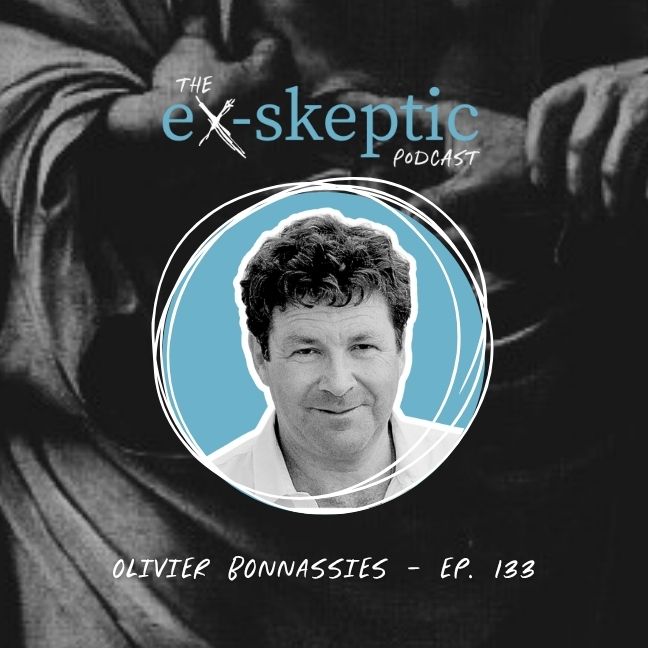
Olivier Bonnassies, co-author of God, the Science, the Evidence: The Dawn of a Revolution, was once convinced that Christianity was irrational and that science explained everything, but he began to question his assumptions about reality, truth, and the origins of the universe. Through years of study in both science and theology, Olivier discovered that the evidence, from cosmology, philosophy, morality, and even history, points unmistakably toward a transcendent Creator.
Together, Jana and Olivier explore:
- How growing up in secular France shaped his skepticism
- The role of scientific discovery in revealing purpose and design
- Why the Big Bang, fine-tuning, and morality point beyond materialism
- How evidence led to faith, and ultimately, to joy and transformation
Guest Bio:
Olivier Bonnassies is a French engineer, entrepreneur, and author with a background in both science and theology. Educated at the prestigious École Polytechnique in Paris, he spent years building successful companies before turning his attention to life’s deepest questions. Once an agnostic, convinced that belief in God was irrational, Olivier embarked on a personal investigation that led him to faith in Christ. He is co-author, with Michel-Yves Bolloré, of God, the Science, the Evidence: The Dawn of a Revolution, a bestselling book in Europe (over 400,000 copies sold) now launching in the U.S. Through his research and writing, Olivier argues that the convergence of science, philosophy, and history reveals a compelling case for God’s existence.
Resources Mentioned:
America’s Christian Credit Union (ACCU): AmericasChristianCU.com/Jana
- God, the Science, the Evidence: The Dawn of a Revolution by Olivier Bonnassies & Michel-Yves Bolloré
- Website: www.godthesciencetheevidence.com
- The Catholic Institute of Paris
- École Polytechnique
- C.S. Lewis Institute — for deeper learning and apologetics resources
- eXskeptic.org — curated playlists including “Can I Believe in Science and God?”
Connect with eX-skeptic:
Website: https://exskeptic.org/
Facebook: http://www.facebook.com/exskeptic
Instagram: http://www.instagram.com/exskeptic
Twitter: http://x.com/exskeptic
YouTube: https://www.youtube.com/@exskeptic
Email info: info@exskeptic.org
Episode Transcript
December 05, 2025
Olivier Bonnassies
00:00 – 00:27
When you discover that providence and prayer works, it changes a lot. And if in the Christians, among the Christians, you have people who can face lions and face persecutions and things like that, it’s not only because they discover by a rational approach that God exists or Jesus is the truth. It’s because they have an experience of this.
Jana Harmon
00:34 – 01:51
Do you ever feel like your values are being challenged? In today’s world, it can seem like our beliefs are constantly under fire. That’s why it matters who you partner with, especially when it comes to your finances. America’s Christian Credit Union stands firm in faith, serves the community, and offers exceptional financial services designed for believers. With their elite checking program, you can take your banking to a whole new level. You can earn up to 4% annual percentage yield on balances under $15,000. You can get paid up to two days early, depending on when your employer sends your paycheck. And you can even receive exclusive discounts on loans. Plus, you’ll enjoy benefits like cell phone protection, identity theft monitoring, and everyday shopping discounts. What really sets ACCU apart is their mission. They’re partnering with Christians nationwide to advance God’s work because your money should reflect your mission. So if you’re ready to bank with purpose, visit AmericasChristiancu.com/Elite to learn more and to make the switch today. America’s Christian Credit Union is federally insured by the NCUA.
Speaker 1
01:53 – 03:09
What if the deepest questions about life aren’t solved by blind faith or by dismissing God, but by following the evidence? I’m Jana Harmon and this is eX-skeptic, where we listen to unlikely stories of belief from former skeptics and atheists. If you’re curious, questioning, or just want to think more carefully about God and reality, you’re in the right place. Today we’re joined by Olivier Bonnassies, an engineering entrepreneur from France who once assumed belief in God was irrational. His journey led him to examine big questions across science, philosophy, history and lived experience. We’ll explore how those threads converged for him and why he now argues that there are robust reasons to believe. In fact, Olivier is the co author of a book that has gotten great attention in France, newly released in English called God, the Science, the Dawn of a Revolution, now launching in the US. We’ll get to that book later, but first let’s hear his own story of moving from disbelief and skepticism to a robust belief in God and in Jesus Christ. Welcome to the eX-skeptic podcast. Olivier, it’s so great to have you with me today.
Olivier Bonnassies
03:11 – 03:14
Very happy also, Jana, very happy to be with you.
Jana Harmon
03:15 – 03:36
Oh, I’m so happy that you’re here and I’m sure that our listeners can already hear that you’re not from the U.S. You’re from Europe, in fact, France. And I’d love for the listeners to know a little bit about who you are, your education, where you live now, and the book that you’re just promoting here in the US.
Olivier Bonnassies
03:36 – 03:50
Yes, you will soon detect a French accent, I’m sure. So my name is Olivier Bonnassies. I’m 59 and I have six children and eight grandchildren.
Jana Harmon
03:50 – 03:51
Wonderful.
Olivier Bonnassies
03:52 – 04:33
When I was 20, I was not a believer. It was a discovery for me. My family was not especially believers also. And I will tell you the story of what happens and why I discovered that it was a big surprise for me that there is a God and there is a very strong rational reasons to believe in God. I discovered this at the age of 20. And now we are with Michel-Yves Bollore . We wrote this book, which was a bestseller in Europe because we sold 400,000 copies in France, Italy and Spain. And now we are launching in the US in October.
Jana Harmon
04:33 – 04:39
So, yeah, for those who are listening, you held up the book, but what is the title of the book?
Olivier Bonnassies
04:40 – 05:24
The title is God the Science, the Evidence and the Dawn of a Revolution. The case is very simple. It’s to say that the existence of God is not a matter of faith. It’s a matter of knowledge, therefore of evidence. And that’s what we are. It’s a classical view. In the past centuries, philosophers or religious people think the same, but now it’s not very well known. And so we are trying to do a review of this with science because science change a lot the landscape.
Jana Harmon
05:24 – 05:32
Yes, science has changed a lot. And I hope to get into more of your book after we talk through your story a little bit.
Olivier Bonnassies
05:32 – 05:44
But it’s quite the same story, in fact, because the reason why I convert and became a Christian were absolutely the same that we are telling in this book.
Jana Harmon
05:45 – 06:09
Yes, there are good reasons to believe. Right. So let’s start back in your childhood. I presume that you were born in France and raised in France. Why don’t you give us an idea of what your family life was like, whether there was religion in the home and whether or not there was religion in the world around you, culturally speaking.
Olivier Bonnassies
06:10 – 11:06
So in fact, my father was a Protestant and my mother was a Catholic. And at the beginning of their marriage they fight against each other. And in one moment this issue was interesting for them. But after a few years, they decide that they cannot make a decision. And when I was young, we never talk about God, in fact, in the family. So I was baptized, my sister was baptized, but I was baptized in the Protestant church. My sister also and the two other brothers were not baptized at the end. So when I was young, I never imagined that I could become a believer because I live in France. France is very secular country where the media and the global vision of the world is without God. In fact, without God. And I was living in this context. And for me, the believers were irrational people believing things, very irrational. Somebody was God in our earth, his mother was a virgin before and after the childhood. And all those things seems to me a little crazy in fact, something that we cannot believe if we are a scientist, if you are rational. But I was not an atheist. I was not a militant. I was what we call an agnostic, in fact. But I was convinced that the believers were irrational. That’s true. And so I was in this mind and I studied science. And I by chance, I was in the best school of science in France, which called Ecole Polytechnique. And I create my first company. And it was a success. I had a good success in the beginning. We earned a lot of money and we have a lot of fun. And after a while, all this give not the, I thought in the past that for me the life was to have success, to have fun, to have a lot of, to discover beautiful things on this planet. But when I began to do things like this, I was not very happy, in fact. It did not give me the happiness I expect. So I asked me a few questions. I said, What are we doing there? Where do we come from? Where are we going? What is the purpose of all this? It’s something that began to perturb me, in fact. And I thought there was no answer to those questions, because if answer exists, people should tell me and it could be well known. So I search, but without searching, because I cannot expect that I can make a decision on such questions. But in one moment, a friend of us, a friend of my uncle, was a very well known scholar and he wrote a book called Is there a Truth? And he was arguing that there is a truth and that we can make the proof of this through reason. So for me it was very curious. And I took this book in order to look at the flow. I was sure that it was not serious. So I took the book and I began to read this. And after a while, a few arguments he had were very strong and I cannot find the flow. So I work on this for weeks and for months and for years at the end. And not only this book, of course, a lot of books. And at the end I was convinced that it was much more solid and serious than what I expected. So I stopped my scientific studies and I went for four years to study theology.
Jana Harmon
11:07 – 12:05
Okay, wow. Okay, there, there’s a lot there. So let, let’s kind of take parts of that story and kind of open those up a little bit because you’ve covered a lot of ground here. So you were, you were growing up in a secular world with a secular worldview. Yes, you were studying science when you were on that track and you looked at the believers along the way, or at least from a distance, and you said, they’re irrational. I’m the rational one. I’m the scientific one. In that period of time, first of all, did you ever meet or know someone who was very serious minded about their faith? Any example of a rationally competent, intelligent Christian? Or were they somewhere distant, somewhere apart, so that you were making judgments about them from a distance or did you know anyone personally?
Olivier Bonnassies
12:06 – 13:42
No. I think you cannot imagine this in the US but in France you can live all your age, your first years of existence without having any question about God. It’s incredible because, so I did not meet believers, priests, we were never speaking of this with nobody. So for me it was not a question for years. It was not a question that we live without this. And it can perhaps it seems very curious for you because at the end in the U.S. you are saying, God bless us, God bless America. In France, in France, nobody, nobody never say something like this. You see, so France is a very secular context. So I did not remember to have met people. Of course, I saw cathedrals, churches, many things like this. But it was, we are, so it’s an habit. We know this country, we know the landscape. So for us it’s not a question for many people. So I cannot say that I had talks with intelligent people about this issue in the past.
Jana Harmon
13:43 – 14:02
And you had a very specific impression of who you thought Christians were as irrational people. So it was the claims of Christianity that seemed so outrageous to you I presume, especially as someone who is scientifically minded.
Olivier Bonnassies
14:02 – 14:42
Yes, also miracles, of course, miracles. You don’t have every day a miracle. So when people say that they believe in miracles and in resurrections and in the Virgin Mary. So it’s okay. You believe in this, you believe in or so all the gods from all the traditions in Greece, in Egypt, in everywhere are curious like this. They believe very strange things. And I said that, okay, many people believe many things, but it’s not serious, it’s mythology.
Jana Harmon
14:43 – 15:02
Yes, it’s not serious, it’s mythology. I think that’s a pretty common understanding that all religions are thrown in the same bucket as being myth and not grounded in rationality or evidence or history or those kinds of things. And that is certainly something that sets Christianity apart.
Olivier Bonnassies
15:02 – 16:30
As some atheists said, there is something like 2000 religions. The question is to say that is there 2000 mistakes or 1999 because one is true. So when you look at the different belief of many, many people, you say, okay, it’s strange and it’s very different. So if there is a truth, why all the people do not believe in this truth, did not make their decision because of evidence. So I think it’s very, you know, when we are speaking of the existence of God, we can say, most of the people think that we cannot make a decision seriously, because you have a lot of believers, a lot of non-believers, very smart and intelligent people in both visions. So why me? With my little brain, I can have a certitude. Certainty. How can I expect to be sure, as many very intelligent people thinks differently? So that was the way, the mind, the way of thinking I had at this time.
Jana Harmon
16:31 – 17:56
But it’s interesting though, even as a secular person and believing that miracles are outside of the scope of reality, you know that mythology is not worthy of belief. There was some sense in which you had some knowledge of what you did know, in a sense or certainty is too strong of a word. But confidence that you knew that what you believed was probably true and what they believed that the religious people probably was not true. Of course in your new work, and we’ll talk about that, you’re contending against the worldviews of naturalism and materialism and how those who believe in those things are more in the irrational camp than the rational camp. That’s your contention. But way back when, when you were a scientist, you know, you were, you were without God. You thought that that was outside the scope of reasonable belief. Did you understand what you were believing? That is, did you embrace naturalism, materialism in its fullness? Did you understand the implications of that worldview at the time? Or were you just kind of going with the flow of your education, your culture? It’s what everybody around me believes that’s intelligent. I mean, did you give it much thought?
Olivier Bonnassies
17:58 – 22:03
No, in fact. I grew. As a common teenager, I never really ask myself this kind of questions. But in one moment, when your scholarity is finished, you have to make a decision what kind of job you will have, what kind of life. So in this moment, it’s much more important to try to make a decision for what will be your life in the future till the end. When you are a teenager, you don’t have to ask, you have good results in school, so you grow and you do the best schools, so you don’t have any question. It’s a one way, it’s a road, very clear. But when you have to decide where you will work, in which company, on which subject, and you will find your first job, you need to find your first job, you have to say, what will be my life in 40 years? What I would like to do. I would like to be this or this, or this. So in this moment it’s more important to, and I understand when I was in this context of reading things about God, I understood that I could not make a serious decision without the answer to this question. Because this question changed everything. When you realize this, if there is no God, if God does not exist, everything is permitted, say Dostoevsky and Sartre and Dawkins, because there is no good or evil, there is no natural law, there is no future, no eternal life. We are just clusters of cells, a particular configuration of atoms brought together by chance, by forces of physics and biology. But there is nothing else, there is no future, no, everything pass us by on earth. So this vision of the world, I realized that it was very pessimistic, perhaps it’s the truth, but it’s very hard because there is no future, no hope, no nobody. We are there only by chance. And if we. Okay, I understood in this moment that this vision is very dark, in fact, but perhaps it’s the reality. I don’t know. If it’s the case, we have to face it. But if God exists, everything changed because somebody wanted you to be there. There is a future, there is an eternity, there is a good, there is an evil, there is a natural law, there is, perhaps you will see your friends, your parents in the future for eternal life. So it’s absolutely not the same vision of the world. So I understood in this moment that if I cannot make a serious decision on this fundamental, decisive issue. It’s not rational, in fact. I have to investigate. I have to look seriously at this question first before making a choice for my life. So that’s why I decided to go for four years studying theology in the Catholic Institute of Paris in order to check if it’s serious or not.
Jana Harmon
22:04 – 23:17
Yeah. So these existential questions, why am I here? What’s life all about? The vision of reality, like you said, is kind of dark. It’s dark without God. And so you were facing those big questions, and I’m impressed that you were willing to go on a journey to figure it out. Is there truth? Can we know it? What is truth? Does it match with reality? Is, you know, and beyond that, you know, what grounds truth? Right. All of those big transcendent questions. Is there a God that informs rationality and truth in our ability to know it? So why don’t you talk with us, just kind of slow walk us through that process, because I’m sure there are a lot of people out there right now who are very curious about the question of God, is there truth? Can I know it? Is it rational? Can you kind of slow walk us through that process? The things that you were finding as you were exploring whether or not you know the answer to those larger questions?
Olivier Bonnassies
23:18 – 36:05
Yes. For me, when I read this book, the two first arguments that were given were not about science. They were first, the people of Israel. The people of Israel. They believed that prophets, not one but dozens of prophets, came in the past and say that in one moment will come somebody that will change the world. And those prophecies were very numerous, they were very strong. And they draw the picture of somebody explaining his life, his death, his destiny, but also his birth. And in the same moment, the time and the moment he will come. And the guy said, the author of this book said it’s unique in the history of humanity. It’s true, it’s historic, and it’s unique in the history of humanity. You cannot find this. You cannot find another people like the people of the Jewish people. So I look at this and I try to find where is the problem? Where is it? Is it true or not? And in fact, you cannot deny that it exists. It’s historical. It’s sure, it’s absolutely sure that people like this in the first century, they believed that the prophets were for perhaps 1 million, 1,000 years. They said a lot of prophecies. And at the end, they were waiting for somebody in this moment. And he was supposed to come very soon. Okay? And this guy, Jesus changed the world. It’s the most important people of the humanity. So, and the people of Israel is a very small people compared to the Egyptian, the Greeks, the Romans. How those people can believe that they will change the world as they are very insignificant. So, it was my first question. And the second one is that this guy said that he can demonstrate the existence of God, saying that all things that exist, if you have something that exists, it could not exist, so it’s not necessary. So it received its existence from a cause. And this cause are perhaps another cause, another cause. But you need a primary cause in order to give the existence to everything. In fact, it’s very, very simple but it’s very, very strong when you finger on it. Because if you imagine a train, an infinite train with cars like this, one after the other. Why, if you are in a rail car, why are you going? Because the one which is before you entrains you. So you cannot imagine an infinite number of cars like this with a movement without a locomotive. You need something to create the movement. Here it’s the same. You cannot imagine an infinite number of causes without a primary cause creating the existence. In fact, I can tell you what strikes me a lot now is how simple all those things are. In fact, it’s very simple, but it’s very strong. So I received those two first arguments, the existence of the people of Israel, believing that somebody coming from their people will change the world because of prophecies, because of God. And second, this idea that all things that exist could not exist, but it exists because of a cause. And those two things were very strong. After this, I study scientific evidence or so of course, and you discover that we live in what we can call a space time, where space time and matter are linked, inextricably linked. You cannot imagine one without the two others. And for many reasons, it’s impossible to have an infinite amount of time in the past. There is a beginning. In fact, in our book, in chapter seven, you can read seven different rational approaches that argues that there is a beginning, not only the Big Bang, but also thermodynamics, rationality, mathematics, physics, cosmology, and many things. So first, we are in a space time. Second, it has a beginning. And third, there is what we call a fine-tuning of every parameter of the universe, not only the initial data, but also all the laws of quantum mechanics, physics, chemistry, biology, and also the value and the ratio of the forces of the universe, the gravity, the electromagnetic. Okay, all this is absolutely adjusted and calibrated and if you change any of the these parameters a little, we are not there to talk about this. So, okay, so if you take those three things, the space, time, the beginning and the fine tuning, it’s very clear, very simple. Because if there is a beginning, it’s not only the beginning of time and matter, it’s also the beginning of space. Because as soon as you have space, you have time and matter. So Georges Lemaitre, the priest who discovered, who made the first theory of the Big Bang. He said, it’s very impressive because it’s the beginning of space. Before, if we can say before there was no space, space was created, and in the same moment time and matter or energy exists. So, if you imagine the beginning of the time, space and matter, the emergence of death, the cause of death, emergence is outside time, outside space, outside matter is transcendent. It has the power to create everything and it calibrated and adjusted everything so that we can be there. So through science you approach the basic definition of God that exists in philosophy or in religion. You see, and what strikes me is very simple. It’s absolutely very simple. And when I discover this, I ask myself, what are the alternatives? What are the vision of the world of the atheists that can explain this? The beginning, the fine tuning? And in fact, if you dig a little, there is nothing I can tell you. A few weeks ago, we were in Princeton and Berkeley and we talked with top scientists, with Nobel Prize winners, and with cosmologists of Princeton and people like this. And I asked them, what are the today the alternatives to God for the fine tuning? They said, multiverse. I say, no, multiverse does not, it’s not possible because of this. And they say, okay, we agree. So what they said, today there is no alternative, but perhaps we will find one day. And I said, but why don’t you accept the God hypothesis? And they answered me, if we accept God we are stopping our research in science. If we said it’s God that explained the fine tuning, okay, it’s a good answer, but we stop science. We are stopping to work to find another solution. So they said, we are trying to find a natural alternative solution for fine tuning. So, fine tuning is an enormous, gigantic, immense problem for the atheist. And second, the beginning, the beginning. There is absolutely no thing to explain the beginning except a transcendent being, because you have only two options. Either you said there is no beginning. There is an infinite amount of time in the past, and today it’s very difficult I can tell you. Even in France we were working with specialists, some of them were atheist or agnostics. And at the beginning of our work they said, we believe that there is an infinite amount of time in the past, it’s possible, or something like that. Now they are not saying this. They admit, after thinking about this with them, they admit there is a beginning, but they have no explanation. You know, some people said there is a beginning from nothing, but it’s crazy. If there is nothing, nothing can come. So, Parmenides, one of the first atheists, he exposed, he claimed a very clear principle in philosophy. In Latin it’s ex nilo nil. From nothing, nothing can come. Everybody agrees, 99% of the people agrees on this because it’s clear if there is nothing, nothing can come. Except if you believe in magic. But so, but in magic you have a magician, you have something, you have something. So from nothing, nothing can come. So Parmenides said, okay, something exists today. So there was no time where there was nothing. Something has always existed by sure. So he said the universe, the universe always existed, but there is another option, the universe has the beginning and something, some being God has always existed. So you have to understand from the atheist principle, you can say nothing has never existed. Something has always been there, something. So if it’s not the universe, it’s God, it’s what we can call God. So for many reasons, there is a beginning, there is a fine tuning, and there is today absolutely no explanation in the atheist vision of the world. And of course the religious vision is okay with all this. So for me, discovering all this was very surprising because the conclusion is clear. The conclusion is that those who are irrational are not the believers, it’s the materialists that are absolutely irrational.
Jana Harmon
36:07 – 37:11
So why in your book, it’s interesting as you introduce it, you infer that there are other reasons other than intellectual reasons why someone might reject what you came to see as true, that there is a God, a transcendent source, a cause sufficient to the effect of our natural world. Obviously you’re sitting here as a believer and we still need to get to that. But, there are those who you inferred that there are those in the name of science, say we were convinced that we’re going to find something, a materialistic, naturalistic explanation. We just haven’t gotten there yet. And they in a sense, put faith in their worldview and excuse these other more viable seeming rational explanations which you were beginning to accept as true and more reasonable. Why do you suppose that atheists or materialists or certain scientists reject this God hypothesis.
Olivier Bonnassies
37:16 – 40:03
I can tell you something. First is that when I was in front of the very strong arguments. In front of which I had no answer and I did not change my mind in five minutes because if, when you are in front of this kind of questions, you need months and years to change your vision of the world. It’s not possible to change like this because all your vision is structured by your background, your answers to this fundamental question. Second, you said, if God exists, my freedom will be limited because I will have to do something and I will have to avoid some other things. Somebody will look at me and judge me and so I will be less happy. I will be in a bad condition because I think my life will be different and I have to renounce, I have to say no to many things. So I will not be happy if God exists. But it’s absolutely false. Of course God want you to be, to be in joy and happiness. So you are looking, everybody is looking at the happiness, but through sometimes very wrong ways. If you are looking for money, power or a lot of things, you think you are doing this because you think you will be very happy with this, but in fact it’s not the case and you know it. If you think a little, we are made to love, to be loved and to transfer love. That’s clear. We are happy when we are in love. It’s the value that dominates everything. So I think after looking at all this, I think that people are prisoners in their visions of the world. But they have to, I hope they will have the same surprise that I had when I was 20, because it’s not always easy, but it’s true. And. The joy that you have when you are in the truth is something incomparable with the rest.
Jana Harmon
40:05 – 41:21
That’s beautiful. So back when you were 20 and you were going through, you were studying, you were understanding these things about the origins of the universe, the fine tuning of the universe, that there was a necessary being and a sufficient cause for the effect. And your vision was being reshaped. How long was it until you came to a point? Of course you’re looking at the Bible too, because you’re studying Israel, right? And the Jewish people and the historic nature and this person coming in the name of, the person Jesus. So there’s reason in the scientific realm and philosophical realm, there’s a sense of revelation in that you’re looking at the prophets, you’re looking who are looking towards this person, Jesus, and I presume it all started coming together for you. This reason, Revelation, history, philosophy, science. As you were moving through this. Talk with us about what that looked like, how long did it take you to come to this place of realization that perhaps this is true? And it’s worth belief.
Olivier Bonnassies
41:23 – 42:59
To say always the same thing. What is very impressive is the convergence and the simplicity of the facts. You know, I think that the most impressive evolution in our world today is the progress of the knowledge at breakneck speed. In fact, the knowledge is progressing everywhere. When you are a child, you are in the fog. You don’t know anything. You are looking at things, but you have absolutely no idea on anything. You have your parents that are very sympathetic people because they give you food and all what you need. So they believe things and they told you some things, and you say, okay, I accept because they are friends. But when you grow and you become a teenager, you begin to ask a lot of questions. What is the reality? I have to make my own decision, my own. I need to have my own vision of everything. So you ask the question, and what is the only way to do this? Is rationality, logos, we say the logos, the rationality. So, you have to make the fog disappear because of the knowledge. And by chance, you are not the only one searching. You have around you a lot of scholars, of scientists, of philosophers, of many, many fields of knowledge.
Jana Harmon
42:59 – 43:57
Earlier in your life, before you changed, your vision was changed about reality. When you thought of Christianity, it was somewhat irrational. The claims of Christianity with the virgin birth and the resurrection, all of those things. But how do you or how did you came to come to the place where you were able to accept these miraculous events? As a scientist, because there, I’m sure that there are some people who could, skeptics who would say, well, yes, maybe, you know, perhaps there’s a God or some kind of transcendent source. But these miraculous claims, they still seem irrational to me. A little bit, a bridge too far. How did you come to accept those miraculous claims? I suppose it has something to do with that God exists then miracles are possible.
Olivier Bonnassies
43:59 – 48:11
No, of course, if you accept that God exists, you can accept that he can make miracles and that it can also reveal itself if he wants. And it’s the only way to know exactly who is God. Because if you, by philosophy or science, you can have the conclusion that God exists, but you don’t know anything about him. So after this, you need another investigation about. Is there a revelation? Because many people think that there is a revelation. You have not only the Christian, but also the Jewish, the Muslims, the Scientologists, the New Age people, I don’t know, a lot of people say we have a revelation. So you have to look, what are the reasons to believe in this? So I can tell you that I’m working those days on a new project after this book. Because this book, we are working on this for four years and I think the arguments are very, very strong. And we made more than 150 conferences and debates, 500 articles in media, and at the end, zero serious objection. So the people told us, okay, God exists, but who is it? So we launched a project that said 1000 Reasons to Believe in Jesus. So I create this magazine, 1000 Reasons to Believe in Jesus about prophecies, about angels and devils. It’s not a mythology, it’s something real. So of course for me it was very surprising. But step by step you discover that it’s the real world. So you have to adapt yourself. If you want to be in the truth, you have to say, okay, I believe it was mythology, but it’s not mythology, it’s the real world. When you have discovered this, you are convinced that. As a way of thinking, you said, okay, I think it’s true. I think it’s true, but it’s, it remains rational. In one moment, you have to change and to say, okay, if it’s rational, it means that God exists and that I can pray and God will answer. And after perhaps four years of searching, when I was sure that it was true, I say, oh, okay, if it’s true, does it work? So I began to pray and I had problems. I had things to. And when you pray and you receive an answer, this answer is very special. It’s never what you expect. It’s never in the timing you expect. It’s something different. But it’s also very precise because sometimes you pray a lot, but in some you have a very precise answer that for you is very convincing. So when you discover that providence and prayer works, it changes a lot. Because today it’s not only rationality, it’s much more large. And if the, in the Christian, among the Christians, you have people who can face lions and face persecutions and things like, it’s not only because they discover by a rational approach that God exists or Jesus is the truth, it’s because they have an experience of this. They have a relation with God and they have dialogue. And so it’s totally different. And. If you are convinced by rationality, you are 100 times more convinced by the experience. Right?
Jana Harmon
48:11 – 48:14
It is not one or the other, it’s both, isn’t it?
Olivier Bonnassies
48:14 – 48:54
Yes, yes, yes. But what is interesting is that through rationality, you can say to all the atheists and the agnostics. Your vision of the world is not right. You have problems. You have a lot of problems. So you have to review this. You have to look again at this issue. And the case is very different than what you imagine. So it’s an opening. But this opening through rationality is very important. But at the end, you have to discover a world, a new world with God.
Jana Harmon
48:54 – 49:24
Yes, yes. And it is an amazing world. I’m curious. Those big questions you were asking when you were 20, what’s, you know, why am I here? What is life all about? All of those things. Did you find sufficient answers to those? Obviously, you’re sitting here. I’m presuming the answer is a profound yes. Did you find your way in this new vision that even those personal questions were answered for you in a meaningful way?
Olivier Bonnassies
49:26 – 50:34
Yes. Of course. The answer, when you realize that all this is true, it changed, and it gives you a joy that you did not have before. For me, when I was young, the death at the end of our life was for me, a question. I was young, so I was not very concerned by death. But I say, I sometimes speak, think on this and say, one day I will be old and I will have to face this question of the death. It’s very curious because what happened, it’s scary. In fact, it’s something. I had a problem with this, but it was not something that I thought every day. But you have a new vision of the world, saying that there is a future, there is an eternity of joy. So it’s absolutely not the same vision.
Jana Harmon
50:35 – 51:37
Yes, it’s amazing, as you say, when you talk about a convergence of data or information or all of these different aspects that we experience and know in the world converge on the reality that God exists. And even our own existential self finds its deep meaning and purpose and value and future. As you were just saying. Only if God exists, right? The God of the Bible, Jesus, who guarantees our eternal life. So I love Olivier, not only the convergence of all of the data and information and reasons, but this, I guess you would call it a cumulative case for the reality of God. You have done such a beautiful, beautiful job of laying out so many different ways that we can know that God is real.
Olivier Bonnassies
51:38 – 54:47
What is important today in the public debate is that people seem to say that this question is complicated, cannot be solved very easily, but it’s not real. The reality is that it’s at the end, very simple. It’s very simple in science. Science can be very complicated. Of course the science is very, is more and more complex and the world is very, is very complex. But the conclusions of science are very simple. So there is a beginning, there is a fine tuning. We are in space time. Okay, a child can understand this. You know, people from just teenager read this and say, I understand, I understand. Because we wrote this book in order to be very accessible to ordinary people. And at the end it’s not complicated. Even philosophy, even the chapter of philosophy is very simple. You know, we are speaking of faith, but I can tell you that scientists, even if they don’t realize this, they need faith. They need faith in the intelligibility of the universe. Because if they don’t believe by faith that the universe is intelligible and that there is laws that are the same on Earth, in the galaxies at the end of the universe, they cannot work. They need faith. And so this science, this philosophy, this morality, this history that we can describe in this book shows you that at the end all is convergent and very simple. And the success of this book, and as I told you, we sold more than 400,000 copies in France, Italy and Spain is because of this accessibility of this very easy to read book and also the fact that it’s very accurate. We made this book reviewed by top scientists in every field. We were in Princeton and Berkeley and we will be soon in Cambridge and Oxford to discuss with the top scientists this new question of the existence of God through science. Because there is not only the fact that we have the beginning and the fine tuning, we have also the last point, the most actual thing, is that all the alternatives have so far failed or are very difficult to sustain today. We are realizing this, we are realizing that. The only option is God in fact, and more and more every day. So that’s the new picture. And I think it could be a revolution, no?
Jana Harmon
54:47 – 55:39
Yes, I hope that it is. I think you have created such again, a beautiful cumulative case, reasonable ground on which to stand for God. And I know, Olivier, that there are skeptics again, curious. And they would love to be where you are in terms of your confidence in the belief in God. And they’re looking at you going, how can I take a step forward? What is the best way to do that? You obviously entered into a four year program. You read that book, that was transformational for you. Perhaps it’s reading your book that might be a good step forward or even reading the Bible. What would you suggest for someone to start really investigating?
Olivier Bonnassies
55:39 – 56:23
God is back through science. So we are not the only ones saying this. There is a wave today. But what is the originity of this book is that it’s very, it’s easy to read. In fact it’s easy to read. And you have 12 different chapters in which you can find independent chapters. You can read the chapter without the former one. And you at the end you make your decision. You are the jury of the investigation. You are free. But if youm I can tell you that the question is now being framed in completely new terms.
Jana Harmon
56:24 – 57:32
Olivier, what an incredible story. You brought us not only your story. Information about God, about good reasons to believe in God and that it is, it is the better vision for reality. You’ve given us just so much to think about, especially for those who are willing to enter in that this is, Christianity is not a blind faith. It is something that is in which all of reality really converges to declare the reality of God. And history proclaims it and philosophy proclaims it and science proclaims it. And I just appreciate all of the hard work that you have done that you are doing to really boldly proclaim this message because it really is life changing. I just want to thank you so much for coming on I again for telling your story and blessings to you in the promotion of your new book because it really is, it can be life changing for many people, Lord willing.
Olivier Bonnassies
57:32 – 57:34
Thank you very much, Jana.
Jana Harmon
57:34 – 58:39
You’re very welcome. Well, what stood out to you? Cosmic beginnings, fine tuning, Israel’s history, or the way a rational search can open the door to a lived relationship with God? If you want to keep exploring, check out Olivier’s book God, the Science, the Evidence and as always, test the evidence for yourself. If this episode helped you, please follow, rate, review and share eX-skeptic. You’ll find more conversations and resources at our website at eXskeptic.org. if you have questions and want to reach out with a past guest, email us@infoeX-skeptic.org and we’ll get you connected. Visit our YouTube playlists especially, ‘Can I Believe in Science and God?’ for stories of people who found belief in both wasn’t only possible, but it was the best way to view reality. And also grab our new eX-skeptic merchandise tee shirts and sweatshirts on our website. eX-skeptic is part of the C.S. Lewis Institute podcast network and produced with excellence by Ashley Kelfer.